Kindness advent calendar for kids: 24 helping and kind-deed ideas by age (free printable)
Published Updated 12 min read
A kindness advent calendar swaps the sweet behind each door for a small helping task or kind deed: one a day from December 1 to 24, picked to fit your child's age. A 4-year-old waters the plants or draws a picture for a neighbor; a 10-year-old cooks a simple dinner or writes to a grandparent. Below are 24 ideas for each age group (3–5, 6–8 and 9–12), a free printable calendar with a picture for every idea, and how to set it up in 10 minutes.
There's no prize for the deed, and that's on purpose. The next section explains why.
Why a helping calendar works
Young children like to help. In a 2006 study in Science, Felix Warneken and Michael Tomasello showed that children as young as 18 months "quite readily help others to achieve their goals in a variety of different situations". The Max Planck Society's summary describes two of them: the researcher hung up laundry and dropped a clothes peg out of his reach, or let a spoon fall into a box he seemed unable to open. The toddlers handed back the peg and fetched the spoon, and only when he looked like he needed it, not when he'd thrown it down on purpose. Virtually all the children helped at least once, and the researcher never asked, thanked or rewarded them.
Rewards can make them help less. In a follow-up study from 2008, 20-month-olds who got a material reward every time they helped were later less likely to help than toddlers who got praise or nothing. The authors call it an overjustification effect. In plain words, helping that came from the child starts to feel like a job done for pay. Praise didn't have this effect, so thanking your child is fine.
Giving feels good, even very early. In a small 2012 study, 20 toddlers just under two years old looked happier when they gave treats to a puppet than when they got treats themselves, and happiest when they gave away one of their own. The authors ask for larger studies before drawing big conclusions.
Older kids gain something too. In a Canadian study, 415 students aged 9 to 11 did three acts of kindness a week for four weeks, while a comparison group visited three places a week and wrote them down. Both groups felt better afterwards. The kindness group also gained more classmates who said they'd like to spend time with them, about one and a half on average. That difference just reached the usual threshold for statistical significance (p = .05), so treat it as a hopeful hint rather than a settled fact.
What the studies don't show: none of them tested an advent calendar, and none can promise that a December of kind deeds will make your child kinder in January. What they support is the idea behind it. Children want to help, a reward for each helpful act can get in the way, and doing something kind is pleasant in itself.
24 kindness ideas for ages 3–5
At this age, every idea is something you do together. Keep it to one small step, and show it before you ask for it. The American Academy of Pediatrics' chores page puts it simply: "Young children are naturally eager helpers."
In 2026, December 5, 6, 12, 13, 19 and 20 fall on a weekend, so the ideas that take longer sit on those numbers.
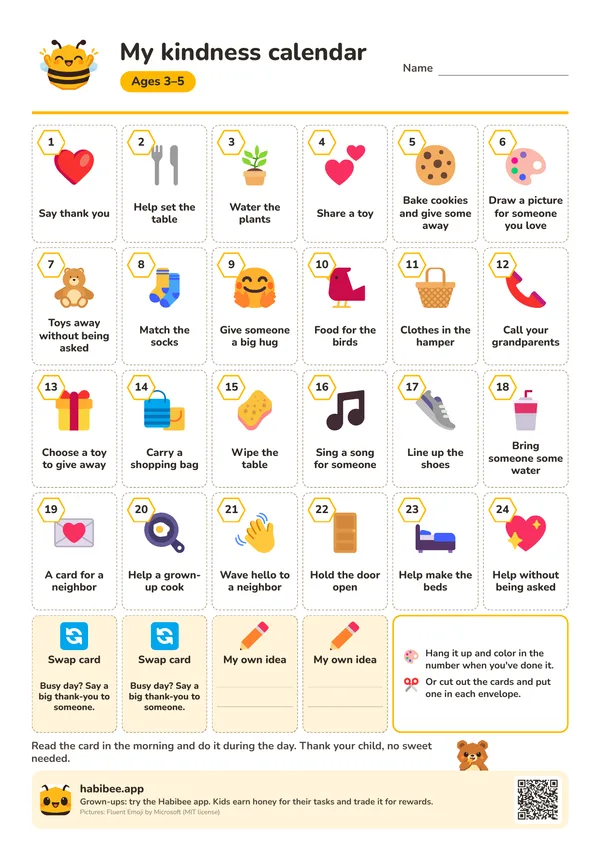
- Say thank you to someone who helps you
- Help set the table
- Water the plants
- Share a toy with someone
- Bake cookies together and give some away
- Draw a picture for someone you love
- Put your toys away without being asked
- Match the socks from the laundry
- Give someone at home a big hug
- Put out food for the birds with a grown-up
- Put your clothes in the hamper
- Call your grandparents or another relative
- Choose a toy to give to another child
- Carry a light shopping bag into the house
- Wipe the table after a meal
- Sing a song for someone
- Line up everyone's shoes by the door
- Bring someone a glass of water
- Make a card for a neighbor
- Help a grown-up cook
- Wave and say hello to a neighbor
- Hold the door open for someone
- Help make the beds
- Help without being asked
Many of these come straight from the task library in our app, where a 3- to 5-year-old sees them as pictures. That's why the printable shows a picture next to every idea: a child who can't read yet can still "read" the card.
24 kindness ideas for ages 6–8
Children this age can do most of these on their own once you've shown them. The AAP's list for 5- to 7-year-olds includes setting and clearing the table and making their own beds, so the helping tasks below are realistic. Baking and anything at a neighbor's door still happen with a grown-up.
- Set and clear the table
- Give someone a real compliment
- Empty the dishwasher
- Read a story to a younger child or a cuddly toy
- Make a card for someone
- Help cook a meal
- Sort the recycling
- Hide a kind note for someone to find
- Unpack the groceries
- Help a brother, sister or friend with something
- Water the plants
- Call your grandparents or another relative
- Sort toys and books to give away
- Fold the laundry
- Let someone else choose the game
- Thank a teacher, coach or bus driver
- Fill the bird feeder
- Feed the pet or give it fresh water
- Bake something to share with a neighbor
- Draw a picture for someone who might feel lonely
- Teach someone a game or a trick
- Put away everyone's shoes and coats
- Help without being asked
- Tell each person at home one thing you like about them
Number 20, and a few ideas in the 9–12 list, are adapted from the Random Acts of Kindness Foundation's free December calendar, which suggests a card "for someone who might feel lonely." A grandparent, an older neighbor or a relative who lives far away are good places to start.
24 kindness ideas for ages 9–12
Preteens can take on real jobs and kind acts outside the family. Several of these match the AAP's chores for ages 8 to 12, such as helping make dinner, changing bedsheets and doing laundry. Anything outside your home, like helping a neighbor, happens with a grown-up along.
- Load or empty the dishwasher
- Compliment someone's effort
- Take out the trash and the recycling
- Help a younger child with reading or homework
- Cook a simple meal for the family
- Write a letter to a grandparent or relative
- Wash the dishes
- Give someone your full attention, with your phone or tablet away
- Fold and put away the laundry
- Walk the dog or play with the pet
- Write a thank-you note to a teacher or coach
- Bake something for a neighbor
- Sort clothes and toys to donate
- Change your bed sheets
- Make breakfast for someone
- Play a game with a younger child
- Help without being asked
- Call a relative you haven't talked to in a while
- Sweep a path or rake leaves for a neighbor
- Pack food for a food bank collection, with a grown-up
- Teach someone something you're good at
- Clean the bathroom sink
- Make a playlist of happy songs for someone
- Write down five kind things people did for you this year
At this age, let your child swap ideas around or write their own. It's their calendar, so give them a say in it.
How to set up a kindness advent calendar in 10 minutes
You don't need to craft anything. Pick one of two ways.
The printable. Download the printable calendar (A4 or US Letter, free). There's one page for each age group: 24 numbered cards with a picture and a short line each, plus two swap cards and two blank cards for your own ideas. Hang the page up as it is and let your child color in the number of each day's card when it's done. Or cut along the dashed lines and put one card in each envelope, box or paper bag.
Envelopes or a jar. Write the ideas on slips of paper, number them 1 to 24, and fold them into numbered envelopes on a string, or into a jar your child pulls from each morning.
Either way, a few things help:
- Read the card in the morning, do the deed during the day. Breakfast is a good moment. If the idea needs you, say when: "We'll call Grandma after school."
- Light ideas on school days. Save baking, letters and anything outside the house for weekends and the holidays. Our lists already do this for 2026, so move cards around if your weekends fall on other days.
- Swap freely before December starts. Take out anything that doesn't fit your family, like the pet card if you don't have one, and put your own ideas on the blank cards.
- Talk about it at bedtime. "Who did you help today? How did they look?" is enough. You don't need a lesson.
- Thank your child, then leave it there. Praise is fine. A sweet or a toy for each deed can turn it back into paid work.
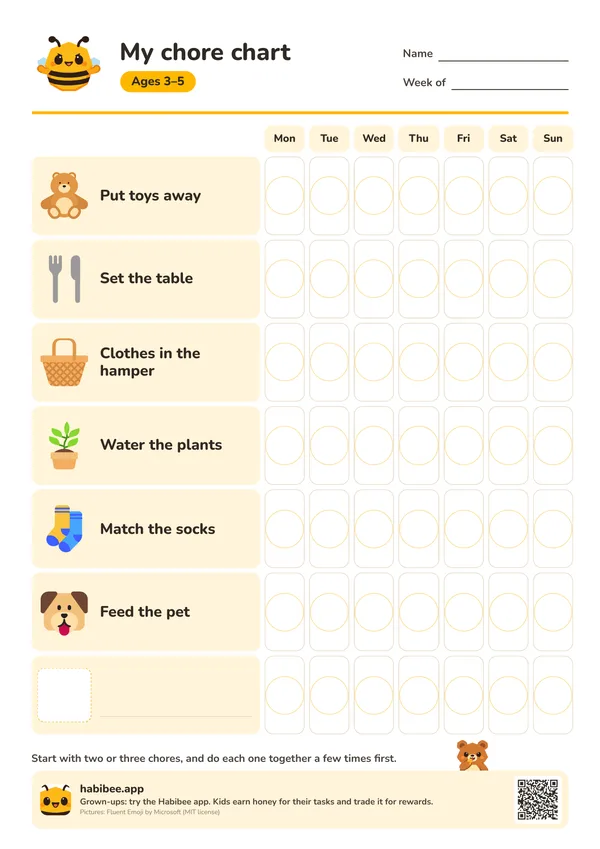
If your child already has a chore chart, the calendar can sit next to it for December. Our printable chore chart and the chart maker work for the regular tasks.
Busy days and days off
Some days will go sideways: a sick child, a late night, a full calendar. Plan for it instead of hoping it won't happen.
Use a swap card. Each printable page has two swap cards with an easy option: say a big thank-you to someone. On a hard day, your child picks the swap card instead of the day's idea. The day still counts.
Don't catch up. If a day gets missed, just do today's card. Three deeds on a Saturday to "make up" for the week turns a kind habit into a debt. Put the missed card in a pile for the holidays, when there's more time, or let it go.
Skip what doesn't fit. Travel, visits and school events eat into December. It's fine if your calendar ends up with 18 good days out of 24.
Keep one helping task after December
By December 24, your child will have tried a couple of dozen small helpful things. Many of them, like setting the table, feeding the pet or emptying the dishwasher, are ordinary chores. Pick one your child liked and keep it as a regular job in January.
The AAP suggests introducing "one new task at a time; a long list can be overwhelming," and praising the effort rather than the outcome. One helping task from the calendar is a gentle way to start. For ideas on what fits which age, see our guides to chores for 3- to 6-year-olds and life skills by age. If getting help means a daily argument, our guide to chores without nagging has a one-week reset.
Regular chores are where rewards can have a place, as long as they're set up to fade out. Our guide to whether reward charts work explains how, and why rewards can backfire.
Frequently asked questions
What do you put in a kindness advent calendar?
One small helping task or kind deed for each day from December 1 to 24, written or drawn on a card. Choose ideas your child can do in a few minutes on a school day, like setting the table or saying thank you, and save bigger ones, like baking for a neighbor, for weekends. The lists above have 24 ideas for each age group.
What if my child doesn't want to do the day's deed?
Don't force it, and don't punish. Offer a choice between today's card and the swap card, or do it together. A child who says no to "call Grandma" may say yes to "let's call Grandma together and you tell her about your day." If refusing is common, the ideas may be too big for your child's age: swap in easier ones.
Should siblings share one calendar?
Either works. Separate calendars let each child have ideas for their age. A shared calendar with deeds you do as a team, like baking for a neighbor or sorting toys to give away, can cut down on comparing who did more. Some families do both: one family deed on weekends and each child's own card on weekdays.
Can there be chocolate in the calendar too?
If chocolate is part of your family's December, keep it, but keep it separate from the deed. Give the chocolate in the morning no matter what, and let the kind act stand on its own. In the 2008 Warneken and Tomasello study, toddlers who got a material reward for helping helped less later on, while praise didn't have that effect. A sweet that always comes with the deed can work like a payment.
At what age can kids do a kindness advent calendar?
From about 3, with a grown-up doing each idea alongside them and pictures instead of words. Toddlers help readily in research studies from 18 months, but counting down 24 days and remembering a card each morning works better from preschool age on.
Does a kindness calendar have to be about Christmas?
No. It's a countdown to the end of the year that works whatever your family celebrates, and you can start any day. Some families run it from the first school day in December, others for the 24 days before a holiday trip.
Habibee's task library already has "Help without being asked" and "Call your grandparents", you can add your own tasks in the free plan, and your child sees each one as a picture on their list. If one of the calendar's deeds becomes a regular job in January, that's the place to put it. Habibee is out in November 2026; join the waitlist at habibee.app.
Sources
- Warneken & Tomasello (2006). Altruistic helping in human infants and young chimpanzees. Science
- Max Planck Society press release (2006): Baby's helping hands
- Warneken & Tomasello (2008). Extrinsic rewards undermine altruistic tendencies in 20-month-olds. Developmental Psychology
- Aknin, Hamlin & Dunn (2012). Giving leads to happiness in young children. PLOS ONE
- Layous, Nelson, Oberle, Schonert-Reichl & Lyubomirsky (2012). Kindness counts: prompting prosocial behavior in preadolescents boosts peer acceptance and well-being. PLOS ONE
- HealthyChildren.org (AAP): Age-appropriate chores for children
- Random Acts of Kindness Foundation: free printable kindness calendars