Bedtime routine for kids: a calm routine by age, with a printable chart
Published Updated 11 min read
A bedtime routine for kids works best when it's calm and the same every night: four to seven quiet steps in the same order, starting at the same time, with screens off for the last hour and your child in bed before the yawning starts. The American Academy of Pediatrics sums up the core in three words: brush, book, bed.
Below is how to pick a bedtime from your child's wake-up time, the routine for each age from 3 to 12, a checklist you can print, and what to try when your child won't go to bed.
Why a bedtime routine helps
A routine tells a child's body and brain what comes next. The AAP's Brush, Book, Bed page puts it simply: "Having a predictable nighttime routine can help your child understand and learn to expect what comes next."
The research is strongest for young children. A 2018 review by sleep researchers Jodi Mindell and Ariel Williamson pulled together the studies. A few findings stand out:
- Consistency matters. In a study of 10,085 children aged 0 to 5 in 14 countries and regions, having a bedtime routine went with an earlier bedtime, falling asleep faster, longer night sleep and fewer night wakings. The review describes the link as dose-dependent: the more consistently a child had the routine, the better the sleep measures looked.
- School-age children benefit too. In a US poll of 1,473 children up to age 10 included in the review, a more consistent routine went with longer night sleep for school-age children as well as for infants and preschoolers.
- It can calm bedtime battles. In one small trial with 36 toddlers and preschoolers who had bedtime tantrums, parents did four to seven quiet activities for 20 minutes before bed. Tantrums dropped about as much as with a gradual ignoring method, and faster.
Most of these studies rely on what parents report, and many measure families at one point in time. The review's authors say themselves that observational studies can't separate the routine from everything else in a family's evening. So the studies show that routines and better sleep go together, which fits what pediatric groups recommend, but they can't promise a result for any one child.
Step 1: set bedtime from wake-up time
Start with the time your child has to get up on school days, then count back the hours of sleep they need. The American Academy of Sleep Medicine's consensus statement recommends:
- Ages 3 to 5: 10 to 13 hours in 24 hours, naps included
- Ages 6 to 12: 9 to 12 hours
Where your child falls in that range varies. A child who wakes easily and stays alert all day is probably getting enough. Use this table to find the time your child should be asleep:
| Sleep your child needs | Wake at 6:30 | Wake at 7:00 | Wake at 7:30 |
|---|---|---|---|
| 12 hours | 6:30 pm | 7:00 pm | 7:30 pm |
| 11 hours | 7:30 pm | 8:00 pm | 8:30 pm |
| 10 hours | 8:30 pm | 9:00 pm | 9:30 pm |
| 9 hours (the minimum for ages 6 to 12) | 9:30 pm | 10:00 pm | 10:30 pm |
That's the time to be asleep. Lights out comes a little earlier, since few children fall asleep the moment their head hits the pillow, and we suggest starting the routine 20 to 30 minutes before lights out.
Two tips from the AAP's sleep advice make this work. Keep the same waking time on weekdays and weekends. And don't wait for signs of tiredness: the Brush, Book, Bed page says "Do not wait for your child to start rubbing their eyes or yawning," and notes that putting a child to bed even 15 to 20 minutes earlier can make a big difference.
If that bedtime makes your mornings impossible, our morning routine guide shows how to shorten the morning before you shorten the night.
Step 2: protect the last hour
What happens in the hour before bed shapes how the routine goes.
- Screens off. The AAP recommends turning off all screens at least an hour before bedtime and keeping TVs, tablets and phones out of children's bedrooms, especially at night. Its 2026 media policy explainer repeats the idea: bedrooms and mealtimes are good places to start screen-free zones, "especially an hour before bed." In the Mindell review, TV and other electronics before bed are grouped with activities linked to poorer sleep.
- Lights down. The AAP suggests dimming the lights before bedtime.
- Calm activities. Drawing, puzzles, a bath, building something quiet. Save wrestling and running games for earlier.
- Room to wind down. The AAP warns against overscheduling evenings. If a sport or lesson ends at 7:30, a 7:45 bedtime won't happen calmly.
If screens are part of your child's reward system, keep earned screen time out of this hour. Our guide to screen time as a reward has age-by-age rules.
A bedtime routine for kids, age by age
Four to seven steps is plenty. Same steps, same order, every night. Most of the steps below come from the task library we built for our app, where each task has an age range. The last column shows how the app handles each by default: a photo taken in the app, "I did it!" with a grown-up check, or points straight away. On paper, a tick works just as well. The timings are our suggestions, so adjust them to your child.
Ages 3 to 5: about 20 to 30 minutes, with you
| Step | Tip | In our app |
|---|---|---|
| Put toys away | Set a 10-minute timer; do the first few together | Photo |
| Bath time (on bath nights) | Keep it calm; save splashy games for the weekend | "I did it!" |
| Put on pajamas | Lay them out in the same spot each night | "I did it!" |
| Brush your teeth | The AAP says young children need an adult's help; use a pea-sized amount of fluoride toothpaste for ages 3 to 6 | "I did it!" |
| Toilet and a drink of water | Do it now, so it isn't a reason to get up later | "I did it!" (as "Use the toilet"); "Drink water" gives points straight away |
| Bedtime story | One or two books; let your child pick | Points straight away |
| Lights out | Same goodnight words or song every night | "I did it!" (as "In bed on time") |
The AAP adds a detail that's easy to miss: "the last thing to touch the teeth before bed is the toothbrush." If there's a snack, it comes before brushing.
Ages 6 to 8: about 30 minutes, with you nearby
| Step | Tip | In our app |
|---|---|---|
| Clothes in the hamper | Right after changing, so they don't end up on the floor | "I did it!" |
| Lay out tomorrow's clothes | One full outfit on a chair; check the weather | Photo |
| Pack your school bag | Folder, snack box, bottle; bag by the door | Photo |
| Bath or wash, pajamas on | Same order every night | "I did it!" |
| Brush your teeth | Still worth a quick check from a grown-up | "I did it!" |
| Reading | A book read together, or 20 minutes alone | "I did it!" |
| Calm breathing | Five slow breaths, then the same goodnight words and lights out | Points straight away |
Laying out clothes and packing the bag are really morning jobs done the night before. They're here because they save the most morning time.
Ages 9 to 12: about 30 to 45 minutes, mostly on their own
| Step | Tip | In our app |
|---|---|---|
| Pack your school bag (and lunch) | Check tomorrow's timetable first | Photo |
| Take a shower | Some kids prefer mornings; pick one and keep it | "I did it!" |
| Floss and brush your teeth | Flossing gets its own step at this age | "I did it!" |
| Devices away | Phones and tablets charge outside the bedroom | Not in the library |
| Read | Paper book or e-reader without games | "I did it!" |
| Calm breathing | Useful on nights with a test or a worry | Points straight away |
| In bed on time | Agree the time together; write it on the chart | "I did it!" |
At this age, let your child own the routine and the chart. Your job shifts to checking in once or twice an evening. Our guide to life skills by age covers how to hand over a routine like this.
Printable bedtime routine chart
Copy the list for your child's age onto a card, or print this page. For children who can't read yet, a picture next to each step works better than words; our guide to chores for 3- to 6-year-olds has a picture chart you can adapt.
Or download the bedtime routine chart as a PDF (A4 or US Letter): the three lists below, one page per age group, with a picture for every step and a box to tick for each night of the week.
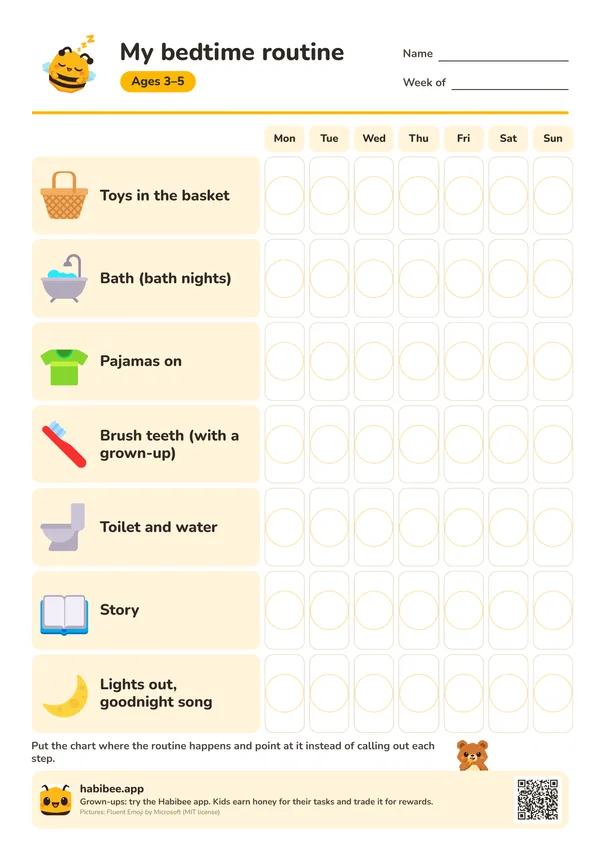
Ages 3 to 5 - [ ] Toys in the basket - [ ] Bath (bath nights) - [ ] Pajamas on - [ ] Brush teeth (with a grown-up) - [ ] Toilet and water - [ ] Story - [ ] Lights out, goodnight song
Ages 6 to 8 - [ ] Clothes in the hamper - [ ] Tomorrow's clothes on the chair - [ ] School bag by the door - [ ] Wash and pajamas - [ ] Brush teeth - [ ] Read - [ ] Five slow breaths, lights out
Ages 9 to 12 - [ ] Bag and lunch ready - [ ] Shower - [ ] Floss and brush - [ ] Devices charging outside the room - [ ] Read - [ ] In bed by ______
Put the chart where the routine happens, like the bathroom door or next to the bed, and point at it instead of calling out each step.
When your child won't go to bed
Most bedtime battles come from a few causes. Work through them in this order.
Check the timing. A child who isn't tired will fight bed, and so will one who's overtired. If bedtime is a struggle every night, one experiment we suggest: move it 15 minutes earlier for a week, then 15 minutes later for a week, and see which goes better.
Build the requests into the routine. "One more drink," "I need the toilet," "one more question": if these come every night, give them a slot before lights out. Once they've had their turn, the answer after lights out is a calm "it's sleep time."
Try a bedtime pass. This one has a small randomized trial behind it. Your child gets one card at bedtime, which they can trade for one short visit from you or one trip out of the room. After that, you calmly ignore further calls. In the trial, 19 children aged 3 to 6 who resisted bedtime were split into a pass group and a comparison group. Children with the pass left their rooms and called or cried out less, settled faster each night, and the effect held three months later. The original 1999 report tried it with two children, aged 3 and 10, so it has been used beyond the preschool years.
Keep the goodnight short and the same. A long, different goodbye every night gives a child something to negotiate with.
Reward the steps, and leave sleep itself out of it. Nobody can fall asleep on command, so a reward for "slept all night" can backfire. Give points for the steps a child controls, like being in bed on time. Our guide to whether reward charts work explains how to set one up so it fades out.
Look at the day, too. The AAP suggests plenty of activity and fresh air during the day. A child who spent the afternoon on the sofa may not be ready at 8 pm.
When to talk to your child's doctor
The AAP lists the most common sleep problems in children as trouble falling asleep, waking at night, snoring, stalling and resisting bedtime, sleep apnea, and loud or heavy breathing during sleep. Sleep problems can also show up in the daytime, as trouble paying attention or "zoning out" at school.
If you notice regular snoring, loud or heavy breathing in sleep, or a child who is tired all day despite a regular bedtime, talk to your pediatrician or family doctor. The AAP notes that "most sleep problems are easily treated," and your doctor may ask you to keep a sleep log first.
Frequently asked questions
What time should a 5-year-old go to bed?
Count back from wake-up time. The AASM recommends 10 to 13 hours of sleep for ages 3 to 5, including naps. For a 5-year-old who no longer naps and wakes at 7:00, that means being asleep somewhere between 6:00 and 9:00 pm. A reasonable starting point is the middle of that range, adjusted by how easily your child wakes up.
What time should an 8-year-old go to bed?
The AASM recommends 9 to 12 hours for ages 6 to 12. With a 7:00 wake-up, that puts sleep between 7:00 and 10:00 pm. Start with 11 or 10 hours (asleep by 8:00 or 9:00) and watch how your child does in the morning and at school.
How long should a bedtime routine take?
We suggest about 20 to 30 minutes of calm steps for most children, a bit longer for older kids who shower and read on their own. In one small trial, the routine that reduced bedtime tantrums was four to seven quiet activities over 20 minutes. The wider wind-down, including screens off, covers the last hour.
Should kids read before bed?
Yes, if it's calm. Reading is the "book" in the AAP's Brush, Book, Bed, and its page says reading aloud together, "even just 15 minutes each day," helps language development and social-emotional skills. A paper book or a plain e-reader fits the screens-off hour; a tablet with games doesn't.
What's a good bedtime routine for a 3-year-old?
Keep it short and the same: toys away, bath on bath nights, pajamas, brush teeth with help, one or two books, lights out with the same goodnight words. Pictures on a chart help a 3-year-old see what comes next.
Habibee turns this list into an evening routine your child can follow with pictures, and you check each step with a tap. It's out in November 2026; join the waitlist at habibee.app.
Sources
- HealthyChildren.org (AAP): Brush, Book, Bed, how to structure your child's nighttime routine
- HealthyChildren.org (AAP): Healthy sleep habits, how many hours does your child need?
- Paruthi et al. (2016). Recommended amount of sleep for pediatric populations: a consensus statement of the American Academy of Sleep Medicine. Journal of Clinical Sleep Medicine
- Mindell & Williamson (2018). Benefits of a bedtime routine in young children: sleep, development, and beyond. Sleep Medicine Reviews
- Moore, Friman, Fruzzetti & MacAleese (2007). Brief report: evaluating the Bedtime Pass Program for child resistance to bedtime, a randomized, controlled trial. Journal of Pediatric Psychology
- Friman et al. (1999). The bedtime pass: an approach to bedtime crying and leaving the room. Archives of Pediatrics & Adolescent Medicine
- HealthyChildren.org (AAP): Helping kids thrive in a digital world, AAP policy explained (2026)