Chores for 3- to 6-year-olds: a realistic list by age (with a picture chart)
Published Updated 11 min read
Chores for 3-year-olds are mostly about their own things: toys back in a basket, pajamas on, today's clothes in the hamper. A 4-year-old can hang up a coat and put spoons on the table. By 5, most kids can make a (lumpy) bed and set the table for everyone. At 6, clearing plates, sorting recycling and folding their own T-shirts are fair game.
The lists below go age by age, from 3 to 6, with what "done" realistically looks like at each age. They come from the task library we built for our app, so each task also has a suggested point value and a note on how you'd check it. Use them with a paper chart, a whiteboard or nothing at all.
Chore list by age
| Age | Chores many kids can do |
|---|---|
| 3 | Put toys in a basket, clothes in the hamper, put on pajamas, brush teeth with your help |
| 4 | Hang up coat and shoes, put spoons and napkins on the table, fresh water for the pet, water a plant |
| 5 | Make the bed (lumps are fine), set the table, feed the pet, match the socks |
| 6 | Clear their own plate, pack the school bag, sort the recycling, fold their own T-shirts, help cook |
| 7–12 | Bigger family jobs such as loading the dishwasher, taking out the trash and cooking a simple meal: see our guide to chores for 7- to 12-year-olds |
Each row builds on the one before. The sections below have the full list for every age, with what "done" looks like.
Why bother at this age
At 3, it's often faster to do it yourself. There's still a decent case for letting them help, with a few caveats.
The American Academy of Child and Adolescent Psychiatry says children who do chores "may exhibit higher self-esteem, be more responsible, and be better equipped to deal with frustration, adversity, and delayed gratification." Note the "may."
The research is mostly correlational, but it points the same way:
- In a US study of 9,971 children, kids whose parents reported more frequent chores in kindergarten rated themselves higher in third grade on academic, social and life-satisfaction measures, even after adjusting for family income and parent education.
- A 2025 study of 125 preschoolers (average age just over 4) found that kids who did more household tasks scored higher on problem-solving. How parents helped mattered: more guidance at the start of a task, then stepping back.
- An online survey of 207 parents, most of them in Australia, linked self-care and family-care chores in 5- to 13-year-olds to better working memory and inhibition.
None of these prove that chores cause the benefits. Kids who are already more organized may simply do more chores. Then again, it's hard to find a downside to a 4-year-old carrying spoons to the table.
Very young children also seem to want to help on their own. In a 2008 study, 20-month-olds who got a material reward for helping later helped less than toddlers who were praised or given nothing. It's one study, with toddlers younger than anyone on this list, but it's a good reason to leave spontaneous helping off the chart and just say "thank you, that was a big help."
How to read the lists
Each task has three extras:
- What "done" looks like. The adult standard doesn't apply. A bed with the duvet pulled up is made.
- Points. Our default value: 1 for quick tasks, up to 3 for big ones. If you use a sticker chart, one point equals one sticker.
- Check. "Look" means go and see (a basket of toys, a made bed). "Trust" means take their word for it. In Habibee, "look" tasks are confirmed with a photo the child takes in the app. On paper, it just means you glance before the sticker goes on.
Every age starts with a starter set of five or six tasks. That's plenty. Add from the rest of the list only once the first ones run without reminders.
Chores for 3-year-olds
At 3, a chore is really "doing it with you." Expect short attention, lots of "I do it!" and results you'll quietly redo. The AACAP list for ages 2 to 3 is short on purpose: putting away toys and groceries, dressing with help.
Starter set: brush teeth (morning), get dressed, put toys away, put on pajamas, brush teeth (evening). That's 5 points on a full day.
| Task | When | What "done" looks like at 3 | Points | Check |
|---|---|---|---|---|
| Brush your teeth | Morning + evening | A real try at the sink; you still help as usual | 1 | Trust |
| Get dressed | Morning | T-shirt and pants on; help with socks and buttons is fine | 1 | Trust |
| Put on your shoes | Morning | Velcro shoes on; the wrong feet still count | 1 | Trust |
| Put toys away | Evening | Toys in a basket, not sorted | 1 | Look |
| Clothes in the hamper | Evening | Today's clothes off the floor and in the basket | 1 | Trust |
| Put on pajamas | Evening | On, even if back to front | 1 | Trust |
| Wash your hands | Anytime | Soap, rinse, dry, with a step stool | 1 | Trust |
| Use the toilet | Anytime | Only if toilet learning is going well; skip it during the hard phase | 2 | Trust |
| Feed the fish | Morning | You measure the pinch, they drop it in | 1 | Trust |
| Say thank you | Anytime | One real thank-you to someone | 1 | Trust |
Chores for 4-year-olds
Four is often when "by myself" starts to mean it. Give instructions in two short steps ("coat on the hook, shoes by the door") and keep the routine identical every day so it can stick.
Starter set: brush teeth (morning), get dressed, wash hands, put toys away, brush teeth (evening). Five points a day.
| Task | When | What "done" looks like at 4 | Points | Check |
|---|---|---|---|---|
| Hang up coat and shoes | After daycare/preschool | Coat on a low hook, shoes roughly paired by the door | 1 | Trust |
| Put on your coat | Before leaving | Arms in and zip started; you finish the zip | 1 | Trust |
| Fresh water for the pet | Morning | Bowl filled at the sink, some spilling allowed | 1 | Trust |
| Set the table | Evening | Napkins and spoons for everyone; you carry the plates | 1 | Trust |
| Match the socks | Anytime | A game: find 3 pairs from a small pile | 1 | Look |
| Water the plants | Anytime | One small watering can, one or two plants | 1 | Trust |
| Wash your face | Morning | Splash, then dry with a towel | 1 | Trust |
Keep the 3-year-old tasks too. Nothing drops off; the standard just goes up a little.
Chores for 5-year-olds
Many 5-year-olds are in kindergarten or about to start school, which makes this a good age for tasks that repeat every day at the same time. The AACAP says 4- and 5-year-olds can help feed pets, make their beds ("maybe not perfectly") and help clear the table after dinner. The AAP list for ages 5 to 7 adds watering flowers, filling pet dishes and putting clothes in the hamper.
Starter set: brush teeth (morning), make your bed, set the table, put toys away, clothes in the hamper, brush teeth (evening). Seven points a day.
| Task | When | What "done" looks like at 5 | Points | Check |
|---|---|---|---|---|
| Make your bed | Morning | Duvet pulled up, pillow at the top; lumps are fine | 2 | Look |
| Set the table | Evening | Plates, cups and cutlery for everyone, roughly in place | 1 | Trust |
| Feed the pet | Morning | Food scooped with a marked cup so the amount is right | 1 | Trust |
| Match the socks | Anytime | The whole basket of socks sorted into pairs | 1 | Look |
| Practice writing | Daytime | Their name, or a row of letters | 2 | Look |
| Put toys away | Evening | Toys in the right boxes now, not just any basket | 1 | Look |
Chores for 6-year-olds
At 6, most kids are in first grade (or the equivalent) and can take on real family jobs, not just self-care. This is also where the list gets longer, because the tasks in our library for ages 6 to 8 open up.
Starter set: brush teeth (morning), get dressed, make your bed, read for 20 minutes, put toys away, brush teeth (evening). Eight points a day.
A note on the reading task: only put it on the chart if reading is a struggle. If your 6-year-old already loves books, leave it off. Rewarding what kids already enjoy is the one thing the research on rewards warns about most clearly (more in our guide on whether reward charts work).
| Task | When | What "done" looks like at 6 | Points | Check |
|---|---|---|---|---|
| Clear the table | Evening | Own plate, cup and cutlery to the kitchen counter | 1 | Trust |
| Pack your school bag | Evening | Folder, snack box, water bottle in the bag by the door | 2 | Look |
| Lay out tomorrow's clothes | Evening | One full outfit on the chair, socks included | 1 | Look |
| Fold the laundry | Anytime | Own T-shirts and towels folded, even if not neatly | 2 | Look |
| Sort the recycling | Anytime | Paper, plastic and glass in the right bins | 1 | Trust |
| Unpack the groceries | Daytime | Fridge and pantry items in roughly the right places | 1 | Trust |
| Empty the dishwasher | Anytime | Start with the cutlery basket only | 2 | Trust |
| Help cook dinner | Evening | Wash vegetables, stir, measure with you next to them | 2 | Trust |
| Clean your room | Anytime | Floor clear. Use a picture checklist: toys, clothes, books | 3 | Look |
Rewards that fit ages 3 to 6
Small kids need rewards that come soon. A simple way to check: divide a reward's cost by the points your child can earn in a normal day.
With the 3-year-old starter set (5 points a day), our default costs work out like this:
| Reward | Cost (ages 3–5) | About how many days |
|---|---|---|
| Extra bedtime story | 5 | 1 |
| Trip to the park | 8 | 2 |
| Choose what's for dinner | 8 | 2 |
| Movie night | 10 | 2 |
| Bake together | 10 | 2 |
| Pick the weekend plan | 15 | 3 |
| Trip to the zoo | 30 | 6 |
For a 6-year-old earning 8 points a day, costs move up (movie night is 15, the zoo 40), which keeps the pace at a similar two to five days.
A picture chart for kids who can't read yet
Most 3- to 5-year-olds can't read a list, but they can "read" pictures. The simplest chart has one row per task, a picture on the left and a box for each day.
For the pictures, photos of your own child doing each task are quick to make and easy for a child to recognize. Drawings or cut-outs do the job too. Keep it to the starter set at first.
| Task (picture + word) | Mon | Tue | Wed | Thu | Fri | Sat | Sun |
|---|---|---|---|---|---|---|---|
| [picture] Brush teeth, morning | |||||||
| [picture] Get dressed | |||||||
| [picture] Toys in the basket | |||||||
| [picture] Pajamas on | |||||||
| [picture] Brush teeth, evening |
Hang it at your child's eye level, near where the tasks happen. Let them put on the sticker or draw the tick. That part is theirs.
Or print our free chore chart by age (PDF, A4 or US Letter). Its first page is a picture chart for ages 3–5, with a box to tick for each day of the week and a free row for a chore of your own.
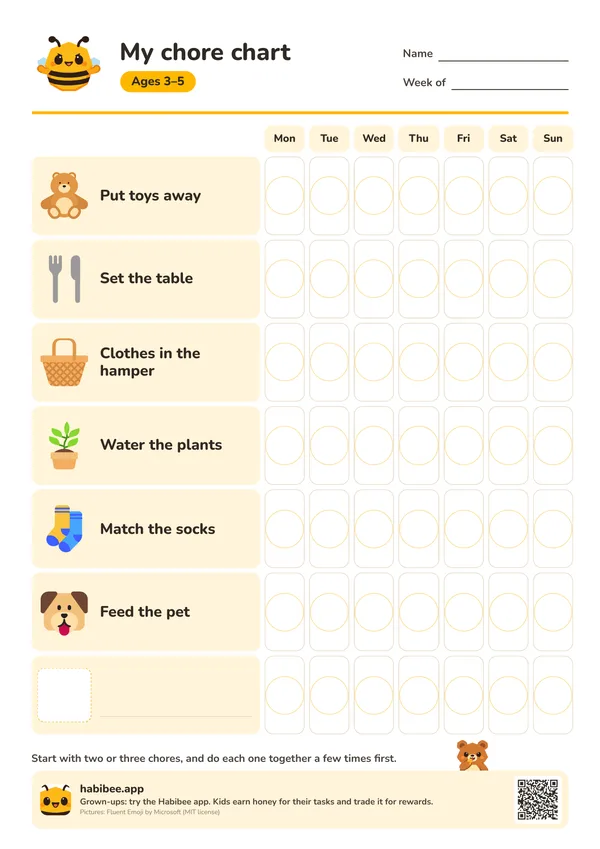
To put your own chores and your child's name on it, use our free chore chart maker. It has the same tasks with pictures, sorted by age.
How to teach a chore to a preschooler
The 2025 preschool study above is a reminder that how you help matters too. These four steps follow the same curve, lots of support at first and less over time:
- Show it. Do it once while they watch, narrating one step at a time.
- Do it together. They do the easy half, you do the rest.
- Watch. They do it, you stay close and keep your hands in your pockets.
- Let go. They do it alone. You check afterward, if it's a "look" task.
Expect this to take a week or two per chore. Praise the effort. The AAP puts it plainly: "Praise your child's effort in each task, not the outcome." And try not to redo it in front of them. If the bed has to be perfect, it isn't their chore yet.
Some days a 4-year-old will do none of it. Start again tomorrow, same order, same chart.
Frequently asked questions
What chores can a 3-year-old do?
Put toys in a basket, put dirty clothes in the hamper, get dressed with help, put on pajamas, wash hands, and feed the fish with a pre-measured pinch. Expect "done" to look very different from your version, and to do most of these side by side.
How many chores should a 4-year-old have?
Start with four or five small daily tasks, most of them self-care (teeth, clothes, hands) plus one or two family jobs like hanging up a coat or putting spoons on the table. Add a new one only when the others happen without reminders.
Should I pay a 5-year-old for chores?
Families disagree. The AAP mentions allowances and stickers tied to chores as options, while others prefer to keep family jobs unpaid. At 5, many parents find that points toward shared experiences (a park trip, baking together) work better than money, which is still abstract at this age.
What if my child refuses to help?
Make the task smaller and do it together. A refused "tidy your room" often becomes a finished "put the cars in the red box." If refusal is constant, check that the chore is truly at their level and that "done" is defined at their standard, not yours.
Habibee turns these lists into a picture-led routine for kids 3–12, with photo proof and real rewards you choose. It's out in November 2026; join the waitlist at habibee.app.
Sources
- AACAP Facts for Families: Chores and children
- HealthyChildren.org (AAP): Age-appropriate chores for children
- White, DeBoer & Scharf (2019). Associations between household chores and childhood self-competency. Journal of Developmental & Behavioral Pediatrics
- Xia et al. (2025). Involvement in household chores and problem-solving abilities among preschool children and the moderating role of parental scaffolding. Acta Psychologica
- Tepper, Howell & Bennett (2022). Executive functions and household chores: Does engagement in chores predict children's cognition? Australian Occupational Therapy Journal
- Warneken & Tomasello (2008). Extrinsic rewards undermine altruistic tendencies in 20-month-olds. Developmental Psychology