Do reward charts work? What the research says, and when they backfire
Published 10 min read
Do reward charts work? Mostly yes, and the research behind them is better than their reputation. They do best with tasks a child finds boring (brushing teeth, putting pajamas on, clearing a plate), a goal you can actually see, a first reward close enough to feel real, and a plan for the chart to disappear. They backfire when they pay kids for things they already love, when the prize is too big or too far off, or when stickers get peeled off as punishment.
The people who say rewards kill motivation have real studies on their side. Read closely, though, most of those studies are about rewarding things children already enjoy, which is exactly what a sensible chart leaves out.
Why pediatricians and psychologists still recommend them
The American Academy of Child and Adolescent Psychiatry tells parents to "set up a star chart or reward system with specific goals to monitor progress and encourage good behavior" in its guide to chores and children. On HealthyChildren.org, the American Academy of Pediatrics calls a chore chart "a visual reminder to keep all members of the family on task" and suggests parents consider "tangible rewards like allowances and stickers tied to completed chores."
The strongest endorsement comes from ADHD care. The CDC calls parent training in behavior management "the recommended first choice in ADHD treatment for children under 6 years of age," and much of that training is about using "positive reinforcement, structure, and consistent discipline." Parents typically go through 8 to 16 sessions with a therapist, which is a long way from a sticker sheet on the fridge. Still, rewarding specific behavior sits right at the center of it.
The case against, and what it actually found
The worry has a name: the overjustification effect. Pay someone for something they enjoy, and they may start doing it for the pay, then stop when the pay stops.
The biggest summary of this research is a 1999 meta-analysis by Edward Deci, Richard Koestner and Richard Ryan that pooled 128 studies. What it found:
- Expected, tangible rewards reduced motivation. When people knew a reward was coming for finishing a task, they later spent less of their free time on that task (effect size d = −0.36 for rewards tied to completion).
- Tangible rewards tended to do more damage to children than to college students.
- Positive feedback went the other way. Praise and other positive feedback increased both free-choice behavior (d = 0.33) and self-reported interest.
There's a toddler version too. In a 2008 study by Felix Warneken and Michael Tomasello, 20-month-olds who got a material reward for helping an adult were later less likely to help again than toddlers who got praise or nothing at all. The authors' reading: even the earliest helping comes from the child, and paying for it can crowd that out.
So the critics aren't making it up.
So do reward charts work? Where both camps agree
Other researchers read the same literature differently. A 2001 review by Judy Cameron, Katherine Banko and David Pierce found that rewards for low-interest tasks increased free-choice motivation. The negative effects turned up on high-interest tasks, and mainly when the rewards were tangible, announced in advance and only loosely tied to how well the task was done.
Put the two reviews side by side and the overlap is practical:
| What the research suggests | |
|---|---|
| Tasks your child already loves (drawing, building, being read to) | Keep them off the chart. Notice them, enjoy them together. |
| Tasks your child finds dull (teeth, pajamas, toys back in the basket) | This is what a chart is for. Rewards help here. |
| Spontaneous helping, especially from toddlers | Say thank you. Stickers can backfire. |
| Praise | Helps in both camps' reading, as long as it's specific. |
A caveat: most of these experiments ran in labs, over minutes or a single session, with puzzles and drawing tasks. Almost nobody has followed an ordinary sticker chart in an ordinary kitchen for months. The studies show which way the risks point. They don't hand you a dose.
Six ways reward charts backfire
1. Rewarding what they'd do anyway
The classic mistake is putting "read a book" on the chart of a kid who already begs for bedtime stories. You've just told them reading is a job that needs paying for. Keep the chart for the boring stuff.
2. Too many things at once
A chart with 12 rows is a to-do list for the parent. For a 3- or 4-year-old, two or three behaviors is plenty. Add one when the first ones run on autopilot.
3. A prize that's too far away
A week is forever when you're four. If the first reward takes 30 stickers, most preschoolers will have lost interest long before sticker 30. Make the first one reachable in two or three days, then stretch the gap.
4. Vague goals
"Be good in the morning" can't be ticked off. "Shoes on before the timer beeps" can. If you and your child could argue about whether it happened, rewrite it.
5. Taking stickers away
After a meltdown, peeling a sticker off is tempting. Don't. Once earned rewards can be revoked, the chart turns from a record of what went well into a threat. Deal with the meltdown on its own terms and keep the chart for good news.
6. A chart that never ends
What happens when the chart comes down? Behavior that stops being reinforced tends to fade, which is why a 2022 systematic review looked at how token systems keep their gains afterward. The most successful approach combined several methods, and the authors recommend that at least one of them hands the job over to other reinforcers. Praise and self-monitoring came up again and again. Most of those studies took place in schools, clinics and treatment programs, not kitchens, but the lesson carries over: plan the exit before you start.
A word on sweets and screen time as prizes
These are the two rewards parents reach for most, and the two with the most side effects.
On screens, the evidence is thin but points one way. In a small Canadian study of 62 children aged 1.5 to 5, kids whose parents used screens to reward or punish behavior had more screen time: mothers' use was linked to more screen time on weekdays and weekends, fathers' use to more on weekends. It's a one-off survey with parent-reported numbers, so it can't prove cause. There's also a simpler argument. Make screens the top prize and you've told your child they're the most valuable thing in the house.
We lean toward experiences instead. These are the suggested costs from the reward list we built for Habibee, in points (the app calls them honey). They work on any chart:
| Reward | Ages 3–5 | Ages 6–8 | Ages 9–12 |
|---|---|---|---|
| Extra bedtime story | 5 | 8 | 10 |
| Choose what's for dinner | 8 | 10 | 12 |
| Trip to the park | 8 | 12 | 15 |
| Family game night | 8 | 12 | 15 |
| Movie night | 10 | 15 | 20 |
| Blanket fort night | 10 | 12 | 15 |
| Bake together | 10 | 15 | 20 |
| Pick the weekend plan | 15 | 20 | 25 |
| Playdate with a friend | 20 | 25 | 30 |
| Trip to the zoo | 30 | 40 | 50 |
To see if a cost is fair, divide it by the points your child can earn on a normal day. A 4-year-old with five one-point tasks earns 5 a day, so movie night at 10 is two days away and the zoo at 30 is about six. For small kids that's a workable mix: a few quick wins and one bigger thing to save for.
A note from our founder: there is an eight-year-old at home who, most days, would rather do almost anything than a chore. That is a big part of why Habibee exists.
How to set up a reward chart that fades out
What you're after is a child who brushes their teeth after breakfast because that's simply what happens after breakfast. The stickers are scaffolding. Build the chart so it can come down.
Pick two or three behaviors. Choose the ones that cause the most friction and are clearly boring. Phrase each as an action you can see: "Pajamas on," "Plate to the kitchen," "Toys in the basket."
Choose rewards together. A 5-year-old who suggested "bake cookies together" cares more about it than one who was handed a prize. Lean on experiences and privileges; save toys for the occasional bigger goal.
Make the first reward close. Two or three days of normal effort. After that, rewards can cost more.
Praise every time, specifically. The AAP's discipline advice gives the model: "Wow, you did a good job putting that toy away!" The praise is what's left when the chart is gone.
Never subtract. Earned is earned.
Plan the fade. When a behavior has run smoothly for two or three weeks, graduate it: make a small fuss, take it off the chart, keep noticing it out loud. Add a new one if you need to, or let the chart shrink. Older kids can take over the ticking while you glance at it, which is the self-monitoring step the token-system research keeps pointing to.
Expect bad days. Some mornings nothing works, chart or not. A chart improves the average. It won't make every day smooth.
Reward chart setup checklist
Print this or copy it into your notes:
- [ ] 2–3 target behaviors, each one a visible action
- [ ] None of them is something my child already enjoys doing
- [ ] Rewards chosen together, mostly experiences
- [ ] First reward reachable in 2–3 days
- [ ] Specific praise every time a box gets ticked
- [ ] Rule agreed: stickers or points are never taken away
- [ ] Chart placed where my child can see and reach it
- [ ] "Graduation" date pencilled in: 3 weeks from today
- [ ] Plan for what replaces the chart (praise, self-ticking, a new goal)
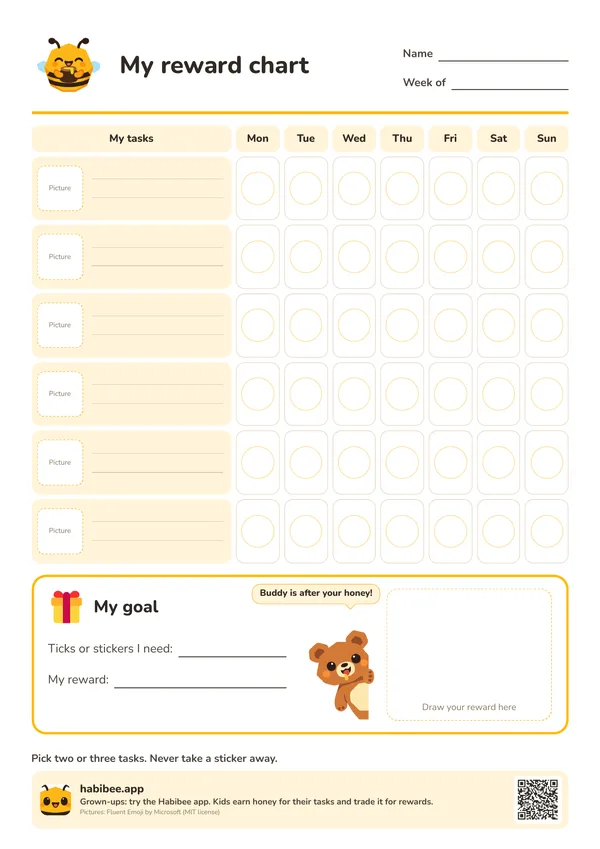
If you'd rather start on paper, our printable weekly reward chart has blank rows for two or three tasks, a box to tick for each day and a goal box for the reward you choose together.
For a younger child who needs the reward sooner than the end of the week, our printable token board has five or ten honeycomb spaces to fill.
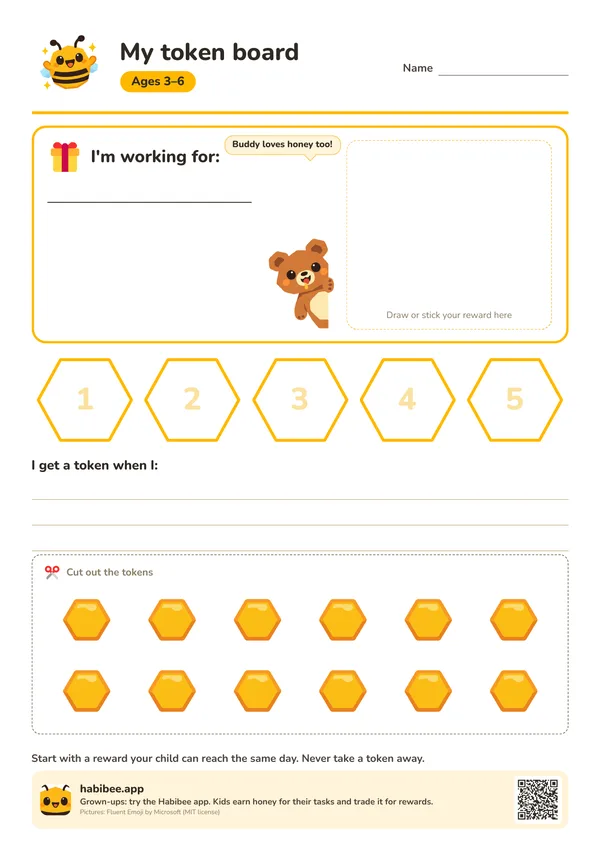
Want your child's name and your own tasks on the chart? Our free chart maker builds a week chart, a sticker chart or a token board, ready to print.
Habibee's defaults follow the same rules: parents choose the rewards, each reward shows the child roughly how many days away it is, and there's no button for taking earned honey back. The one exception is opt-in. Buddy the Bear turns up when tasks go undone for a few days, and only if you switch it on in settings can Buddy walk off with a small share of the honey. If you're sticking to never-subtract, leave it off. A paper chart and a pen can follow every one of these rules too.
Frequently asked questions
Do reward charts work for 3-year-olds?
They can, if the chart is simple and the reward is near. At three, pick one or two behaviors, use pictures instead of words, and make the reward something that happens today or tomorrow. If pressing the sticker on turns out to be the fun part, great. You don't need a bigger prize.
Are reward charts okay for kids with ADHD?
Many families with ADHD use visual charts and rewards, and rewarding specific behavior is part of the parent training the CDC recommends as the first choice for children under 6. An ADHD-friendly chart usually has fewer steps, more pictures, and smaller rewards that come more often. This article is written by a parent, not a clinician. If you're worried about your child, talk to your pediatrician.
How long should you use a reward chart?
There's no fixed number. A practical rhythm: review every two to three weeks, graduate what's working, and aim for a chart that's noticeably smaller after two or three months. If nothing has improved after a few weeks, the chart probably needs smaller goals or closer rewards, not more of the same.
Should I pay my child for chores instead?
That's a separate question, and the advice splits. The AAP's chores page suggests considering "allowances and stickers tied to completed chores," while others argue that everyday family jobs should stay unpaid and money (allowance, or pocket money in the UK and Australia) should be about learning to manage it. It gets its own guide soon.
Habibee is a reward chart app for kids 3–12, with real rewards you choose, photo proof and no ads. It launches in November 2026; the waitlist is open at habibee.app.
Sources
- Deci, Koestner & Ryan (1999). A meta-analytic review of experiments examining the effects of extrinsic rewards on intrinsic motivation. Psychological Bulletin
- Cameron, Banko & Pierce (2001). Pervasive negative effects of rewards on intrinsic motivation: The myth continues. The Behavior Analyst
- Warneken & Tomasello (2008). Extrinsic rewards undermine altruistic tendencies in 20-month-olds. Developmental Psychology
- Regnier et al. (2022). A systematic review of treatment maintenance strategies in token economies. Perspectives on Behavior Science
- Tang, Darlington, Ma & Haines (2018). Mothers' and fathers' media parenting practices associated with young children's screen-time. BMC Obesity
- CDC: Parent training in behavior management for ADHD
- AACAP Facts for Families: Chores and children
- HealthyChildren.org (AAP): Age-appropriate chores for children
- HealthyChildren.org (AAP): What's the best way to discipline my child?