Screen time as a reward: what the research says, and a safer way to use it
Published Updated 12 min read
Screen time as a reward works in the moment, which is why so many families use it. The research is thin and mostly survey-based, but it leans one way: children whose parents hand out screens as a reward, or take them away as a punishment, tend to spend more time on screens overall. Several pediatric sources advise against it for that reason.
You don't have to ban it. If screens are part of your reward system, keep the earned amount small and capped, never in the hour before bed, and put other rewards your child wants just as much next to it. Below is what the studies found, what pediatric groups say, and age-by-age rules that keep screens from becoming the only currency in the house.
Should screen time be a reward? The short answer
For most families, screens work better as a fixed part of the day than as a prize. A fixed slot ("after homework, 30 minutes, then off") gives your child something to look forward to without turning every request into a negotiation about minutes.
If you do want screens on the reward list, three conditions make it safer:
- It's a small bonus, on top of a normal daily amount that doesn't depend on behavior.
- It has a ceiling. Earned minutes don't pile up into a five-hour Saturday.
- It's one reward among several. A trip to the park or choosing dinner should cost about the same, so screens don't become the thing everything else is measured against.
For children under 5, we'd skip screen rewards altogether. The reasons are below.
What the research says about using screen time as a reward
Two studies look at exactly this question. Both are surveys that measure families at one point in time, so they show links, not causes.
Young children (ages 1.5 to 5). A Canadian study of 62 children from the Guelph Family Health Study asked mothers and fathers separately how they handled screens. Mothers' use of screens to control behavior, as a reward or a punishment, was linked to more screen time for their children on weekdays and weekends; fathers' use was linked to more on weekends. The families had higher incomes than the Canadian average, most were white, and a parent reported the child's screen time, so the authors say the results may not carry over to other families. In the university's summary, the difference came to about 20 extra minutes a day on weekends. Jess Haines, one of the researchers, compared it to food: "When you give food as a reward it makes children like the carrot less and the cake more. Same thing with screen time."
Early adolescents (ages 12 to 13). A much bigger US study of 10,048 young teens from the ABCD Study asked parents about their media rules and the teens about their own screen use. Almost 40% of parents said they offered screen time as a reward for good behavior, and a little over three-quarters said they took it away as a punishment. Using screens to control behavior was linked to more screen time and to higher scores on a problematic video game use questionnaire. Two other habits pointed the other way: parents who monitored screen use and set limits had children with less screen time. This is also a one-time survey, and the authors say it can't show what causes what.
The teens in that study are older than most of the children this guide is about, and the authors mention one earlier study that found no link between rewarding with screens and children's weekly TV viewing. So the evidence is limited and can't prove that rewards cause more screen time. What there is leans toward screens becoming more attractive when they're used as a prize.
We couldn't find a trial that tested the popular "earn screen time" chart at home. If you use one, you're making a judgment call, and the rules below are meant to make that call a careful one.
What pediatric guidance says
The advice isn't unanimous, which is useful to know when you read a confident blog post in either direction.
- Against: Seattle Children's screen time guidance says: "Avoid using screen entertainment as a reward or as a way to calm or soothe a child." The same page advises no screens in the hour before bed and no mobile devices in the bedroom at night.
- More relaxed: the American Academy of Pediatrics' chores page says you might "revoke certain privileges or special activities" when chores are skipped, while calling encouragement and rewarding successes "much more effective" than scolding. It adds: "Remember that electronic devices and screen time are privileges, not rights."
- The bigger picture: in 2026 the AAP replaced its older media guidance with a new policy statement, published in the February issue of Pediatrics. Its explainer for parents says the goal is to "move beyond simple screen-time limits and focus on quality, context and conversation." It recommends a family media plan, suggests screen-free zones starting with bedrooms and mealtimes, "especially an hour before bed," and asks parents to model the habits they want to see.
- For under-5s: the World Health Organization's 2019 guidelines say that for children aged 2 to 4, sedentary screen time "should be no more than 1 hour; less is better."
The AAP explainer also points out that many apps already run on their own rewards, from "rewards that keep them playing" to apps that "reward kids just for signing in." A family reward paid in screen time sits on top of that.
Why screens make a tricky prize
Screens behave differently from most rewards.
They're already the top prize. Most children don't need to be taught to want a tablet. Making it the main reward confirms that it's the most valuable thing on offer, and everything else gets measured in minutes.
They're hard to stop. A park trip ends when you walk home. A game has no natural end, and the handover back to real life is often where the trouble starts. Our guide to a child who doesn't want to do anything covers that switch in more detail.
They invite bargaining. Once minutes are currency, every task gets a price. "How much screen time is emptying the dishwasher worth?" is a fair question from a 9-year-old, and a tiring one to answer every day.
No study has looked at an occasional 30-minute bonus on a Saturday, and the surveys above measured the habit, not the one-off. What they do suggest is that screens need firmer guardrails than stickers or a trip to the park.
Screens as a prize, a bank or a schedule
Parents who say they "reward with screens" usually mean one of four setups. They behave very differently.
| Setup | How it works | Upside | Watch out for |
|---|---|---|---|
| Prize | Good behavior earns screens; bad behavior loses them | Works in the moment | Screens become the main lever for everything; this is the pattern the studies looked at |
| Bank | Each chore earns minutes ("earn screen time" chart) | Clear and easy for kids to understand | Minutes pile up; every task gets a price; weekends can turn into long sessions |
| Schedule | A fixed slot at a fixed time, after the day's routine ("first homework, then screens") | Predictable, no bargaining, easy to keep the same every day | Needs you to hold the time limit, since nothing is "earned" |
| Bonus | A fixed daily slot, plus a small, capped extra that can be earned | Keeps some motivation without making screens the whole system | Keep the cap low and the extra occasional |
The schedule and bonus setups keep screens predictable, which is what most pediatric advice is aiming for. No study has compared these four directly, so treat the table as a way to think it through, not as a ranking from research.
Age-by-age rules for earned screen time
These are our suggestions, built on the sources above. Adjust them for your family.
| Ages 3–5 | Ages 6–8 | Ages 9–12 | |
|---|---|---|---|
| Screens as a reward? | Skip it. Use experiences and small things instead | Only as a small bonus on top of a fixed daily slot | Possible as a bonus; better still, agree on a family media plan together |
| Daily screen time comes from | A short, fixed slot, ideally watched together (WHO: no more than 1 hour at ages 2 to 4) | A fixed slot at the same time each day | A plan your child helped write: when, where, what counts |
| Size of an earned bonus | None | 15 to 30 minutes | 30 minutes |
| Cap | None needed | One bonus a day at most | One bonus a day, no banking beyond the weekend |
| When | Never to calm a meltdown | After the routine, not before bed | After the routine; screens out of the bedroom at night |
| What else they can earn | Extra story, park, baking | Choose dinner, game night, playdate | Pick the weekend plan, bike ride, a friend over |
Two rules hold at every age:
- Earned is earned. Don't take earned minutes back as a punishment for something unrelated. Taking rewards away is one of the ways reward charts backfire.
- The last hour before bed stays screen-free. Seattle Children's advises it and the AAP explainer suggests it, and it protects sleep for everyone.
Where screen time sits in a reward list
When screens are one option among many, they lose some of their pull. Here is how the two screen rewards sit among the suggested costs in the reward list we built for our app, in points (the app calls them honey). Screen time is priced next to experiences on purpose, so it isn't the obvious "best deal". The full list of non-screen rewards is in our reward charts guide.
| Reward | Ages 3–5 | Ages 6–8 | Ages 9–12 |
|---|---|---|---|
| Choose what's for dinner | 8 | 10 | 12 |
| 30 min screen time | 8 | 10 | 12 |
| Trip to the park | 8 | 12 | 15 |
| 30 min video games | 10 | 12 | 15 |
| Bake together | 10 | 15 | 20 |
| Playdate with a friend | 20 | 25 | 30 |
For a sense of scale: the app's starter set for a 7-year-old (brush teeth twice, make the bed, homework, set the table, pack the school bag) earns 10 honey on a day when everything is done. That's the same as 30 minutes of screen time, and 2 short of a park trip. A bonus should feel like a bonus, not like the reason the day exists.
We lean toward experiences as the headline rewards and keep screens as a side option. You can adapt the list to your family.
Should you take away screen time as a punishment?
This is the other half of "screens to control behavior," and it's even more common. In the ABCD study, about three in four parents did it. The same study found that reward and punishment together were linked to more screen time, not less.
If you use consequences, tie them to the screen itself. "The game went past the agreed time, so tomorrow's slot is shorter" connects the consequence to what happened. "You were rude to your sister, so no tablet tonight" turns screens into the all-purpose lever, which is the pattern the research warns about. For chores, a consequence linked to the task works better; our guide to chores without nagging has examples.
An earn-screen-time setup that doesn't take over
If you've decided to try it, this checklist keeps it contained. Copy it onto the fridge or into your notes.
- [ ] A fixed daily screen slot exists, and it doesn't depend on behavior
- [ ] Earned screen time is a bonus of 15 to 30 minutes, with a daily cap
- [ ] No banking beyond the weekend
- [ ] Screens are priced like other rewards, and there are at least four non-screen rewards on the list
- [ ] The routine comes first; screens come after, at a fixed time
- [ ] The stopping point is agreed before the screen goes on (end of the episode, a timer)
- [ ] Nothing earned gets taken away for unrelated behavior
- [ ] No screens in the hour before bed, and no devices in the bedroom overnight
- [ ] Review in three weeks: are arguments about minutes going up or down?
If arguments go up, switch from the bank to the schedule. Some families find that simply knowing screen time will happen at 5:30 every day ends most of the bargaining.
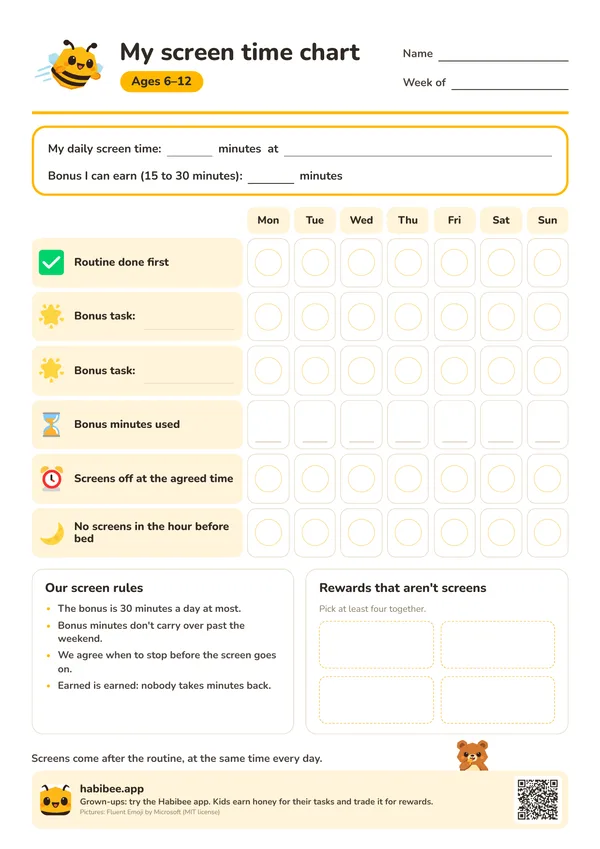
If you want the setup on paper, our earn screen time chart puts the fixed slot, the capped bonus and these rules on one page, with room for rewards that aren't screens.
Frequently asked questions
Is it bad to use screen time as a reward?
No study has tested small, occasional screen rewards on their own. What the research does look at is the habit of using screens as a reward or punishment, and survey studies of preschoolers and young teens both link that habit with more screen time overall. The evidence is limited and can't prove cause, but it's a reason to keep screen rewards small and capped rather than making them the main prize.
Should kids earn screen time with chores?
It can work if earned time is a small bonus with a ceiling and the child also has a fixed daily slot. If all screen time has to be earned, every chore gets a price in minutes and weekends can turn into long sessions. Many families find a fixed slot after the day's routine causes fewer arguments.
How much screen time should a child be able to earn?
There's no official number. The AAP's 2026 policy moved away from simple time limits and toward quality, context and family plans. The WHO says no more than 1 hour a day for ages 2 to 4. For school-age kids, a bonus of 15 to 30 minutes, at most once a day, keeps earned time from becoming the main event.
What rewards work better than screen time?
Experiences and privileges: an extra story, choosing dinner, a trip to the park, baking together, a family game night, picking the weekend plan. They cost you time more than money, and they don't need a stopping fight. Our guide to whether reward charts work has the full suggested list with costs by age and shows how to set a chart up so it fades out.
In Habibee, screen time is one reward among many. You decide what goes in the Hive and what it costs, and your child sees roughly how many days away each reward is. It's out in November 2026; join the waitlist at habibee.app.
Sources
- Tang, Darlington, Ma & Haines (2018). Mothers' and fathers' media parenting practices associated with young children's screen-time: a cross-sectional study. BMC Obesity
- University of Guelph via ScienceDaily (2019): Controlling children's behavior with screen time leads to more screen time, study reveals
- Nagata et al. (2024). Associations between media parenting practices and early adolescent screen use. Pediatric Research
- Seattle Children's: Screen time and digital media use
- HealthyChildren.org (AAP): Helping kids thrive in a digital world, AAP policy explained (2026)
- HealthyChildren.org (AAP): A child-friendly digital world, AAP releases new media recommendations (2026)
- HealthyChildren.org (AAP): Age-appropriate chores for children
- World Health Organization (2019): To grow up healthy, children need to sit less and play more