To get kids to do homework without a fight every evening, take the daily decision out of it. Homework happens at the same time and in the same place each school day, starts with a short ritual, and you stay close by without doing the work yourself. When it's done, you look it over together. A lot of the arguing is about when and whether, and a routine settles both before anyone gets tired.
This guide is for school-age children, roughly 6 to 12. Below is what the research says about parents and homework, how much homework is typical, a five-step routine, how to help without taking over, and what to try when your child refuses.
Why kids fight homework
A child who refuses homework usually has a reason, even if they can't put it into words. The common ones:
- Bad timing. Hungry, tired, or straight from a long day with no break.
- They don't know where to start. The task looks big, or the instructions didn't make sense in class.
- It's too hard, or too easy. Both feel pointless to a child.
- Something better is waiting. Play, a screen, a sibling who has no homework.
- The battle has become the routine. If homework always ends in an argument, the argument starts before the books come out.
The first four are practical problems with practical fixes. The last one is what the routine is for: once the first four are handled for a few weeks in a row, there is less left to fight about.
What research says about homework and parents
A few findings shape the advice in this guide.
For young children, homework is mostly about the habit. A 2006 synthesis of US homework studies by Harris Cooper and colleagues found generally consistent evidence that homework helps achievement. The link was stronger in grades 7 to 12 than in kindergarten to grade 6. We read that as a reason to focus on a calm, steady routine for a 7-year-old rather than on extra minutes.
Structure helps; doing it for them doesn't. A 2008 research synthesis by the same group found that training parents to get involved in homework led to higher completion rates and fewer homework problems among elementary school children. Parents setting rules about homework had a stronger link with achievement than the other kinds of involvement they looked at. For middle school students the link between involvement and achievement was negative, and the authors conclude that the kind of involvement that helps changes as children move up through the grades.
How you help matters more than how often. A study of 1,685 sixth graders found that the amount of parental help went with weaker progress, while help that children saw as supportive went with better progress and help they saw as intrusive with worse. A study that followed 2,830 students in non-academic school tracks from grade 5 to grade 7 found a similar pattern: more parental control was followed by weaker school functioning later, while responsive help and clear structure were followed by better functioning.
These are observational studies, so they show patterns rather than causes. Children who struggle tend to get more parental control to begin with; the grade 5 to 7 study saw exactly that. Still, the studies point the same way. Set the frame, stay warm, and leave the thinking to your child.
How much homework is normal?
The U.S. Department of Education's booklet Helping Your Child with Homework passes on a guideline from national parent and teacher organizations:
| Grade (age) | Suggested homework per school day |
|---|---|
| Kindergarten to grade 2 (about 5 to 8) | 10 to 20 minutes |
| Grades 3 to 6 (about 8 to 12) | 30 to 60 minutes |
| Grades 7 to 9 | More, and it may vary from night to night |
The booklet adds that reading at home can push the time a bit beyond these amounts, and that some children and situations differ. Schools and countries vary a lot here. If your child regularly spends far longer than this, or homework never seems to come home, talk to the teacher before you change anything at home.
How to get kids to do homework: a routine in five steps
1. Pick the time together
There's no single right time. The booklet puts it plainly: "The best schedule is one that works for your child and your family." Some children work best right after a snack, some after an hour of play, some after dinner. The one time it rules out: "don't let your child leave homework to do just before bedtime."
Let your child choose between two or three times that work for you, then keep it. If after-school activities change the day, write the plan for each weekday where everyone can see it. Our morning routine guide uses the same trick for school mornings.
2. Set up one place
Some families call this a homework station, and it doesn't need to be a desk. The booklet notes that "for many children, the kitchen table or a corner of the living room works just fine," as long as it has good light and is fairly quiet. Keep pencils, eraser, sharpener, ruler and paper in one box, so "I need a pencil" doesn't turn into ten minutes of wandering. Your child may enjoy decorating the box or the corner. TV off, phone away; the booklet allows quiet background music for children who work well with it.
3. Start the same way every day
A short start ritual makes sitting down automatic. Ours, as a suggestion: snack and drink first, bag open, planner or homework sheet out, and your child tells you in their own words what today's tasks are. That last step comes from the booklet's list of questions for parents: once your child has read the instructions, ask them to tell you in their own words what the assignment is about. If they can't, you've found the real problem before it becomes a fight.
4. Work in chunks, with breaks
Big assignments shrink when they're split. KidsHealth's homework tips suggest breaking the work "into manageable chunks" and taking "a 15-minute break every hour, if possible." For a 6- or 7-year-old, we'd make the chunks much shorter, like one worksheet, then stand up and stretch. The booklet also says that if your child shows signs of frustration, let them take a break and show that you know they can do the work.
5. Finish with a look-over and the bag
When the work is done, look it over together. The booklet suggests checking that an elementary school child has finished the assignments, and checking a middle schooler's work too if they're having trouble finishing. Then everything goes straight into the school bag. Packing the bag right after homework means one less job in the morning.
The routine by age
| Ages 6 to 8 | Ages 9 to 12 | |
|---|---|---|
| Who sets the time | You offer two or three choices | Your child proposes, you agree |
| Where you are | In the same room, doing your own quiet thing | Nearby; you check in once or twice |
| Chunks | One page or one task at a time | 20 to 30 minutes, then a short break |
| Planning | You write the day's list together | Your child writes it; weekly plan for projects and tests |
| Finish | You look it over together | You look over what they show you; more for subjects they find hard |
How to help without taking over
The booklet's basic rule is "Don't do the assignments yourself," because the homework belongs to your child. KidsHealth says the same: "it's a kid's job to do the learning." You can still help plenty, as long as your child keeps doing the thinking:
- Ask before you explain. "What is the question asking?" "What did you try?" "Does your answer make sense to you?" The last one is straight from the booklet's checklist.
- Show with a different example. If your child is stuck on a type of problem, work through a similar one together, then hand the real one back.
- Leave mistakes for the teacher to see. Wrong answers tell the teacher what to teach again, and KidsHealth also says kids should be allowed to make their own mistakes.
- Keep your voice neutral. The research above found that help children experience as intrusive or controlling goes with worse results. If you feel your patience going, take a break yourself.
- If you don't understand it either, the booklet suggests calling a classmate or contacting the teacher. Saying "let's ask" is a fine answer.
Praise the effort, specifically. The booklet suggests comments like "Good first draft of your book report!" and making criticism constructive: rather than "You aren't going to hand in that mess, are you?", try "The teacher will understand your ideas better if you use your best handwriting."
When your child refuses to do homework
If the routine is in place and your child still says no, work through these in order.
Check the basics first. Food, a break after school, and enough sleep. A tired child at 7 pm will fight anything. Our bedtime routine guide has the sleep hours by age.
Stay with them for the first five minutes. Starting is often the hardest part. Sit down together, read the first question, then step back to your own task. This is our suggestion, and it fits the "be available" advice in the booklet: many elementary school children like to have someone with them to answer questions.
Keep homework time even on light days. The booklet describes families with a set amount of time for homework or other learning each school night. A child who knows the time is the same either way has less reason to rush, or to "forget" the homework at school. On days without homework, they read.
Use "first, then". "First homework, then the park" is calmer than "No park until you've done your homework!" The rule is the same; it just sounds like a plan.
Reward the steps your child controls. In one small study with four children who had serious homework problems, goal setting plus a written parent-child agreement about homework goals and what follows when they're met (a contingency contract) improved how accurately they did their homework, and two of the four also stayed on task more. That's only four families, so treat it as a hint. If you try a chart, reward what your child controls: sitting down on time, finishing, packing the bag. Our guide to whether reward charts work shows how to set one up so it fades out, and if screen time is the prize, read screen time as a reward first.
Don't let it become nagging. If you're repeating "homework!" every ten minutes, the reminder has become the start signal. Our guide to chores without nagging shows how to move the list out of your head and switch from reminding to checking. It works for homework the same way.
Look wider if it's not just homework. If your child has lost interest in most things, schoolwork included, start with our guide for when a child doesn't want to do anything.
When to talk to the teacher, or get more help
The booklet suggests contacting the teacher if your child refuses to do assignments even though you've tried hard, if instructions are unclear, if assignments seem too hard or too easy, or if homework arrives in uneven piles (nothing for three days, then four assignments due tomorrow). It also suggests talking to each teacher early in the school year, before problems come up, and asking how much they want parents to be involved, since that varies from teacher to teacher.
If the problems keep going, KidsHealth suggests getting help: some children need glasses, and others "might need an evaluation for a learning problem or attention disorder." A child who works hard and still can't finish, or who struggles with reading or focus in class too, is worth raising with the teacher and your child's doctor.
Printable homework chart
To make the routine visible, add homework to a weekly chart. Our free chart maker with homework already added prints a week chart with your child's name, a picture for each task and a box for each day. Change the tasks to fit your child. If you'd rather write in the times yourself, the daily routine chart has space for an after-school plan.
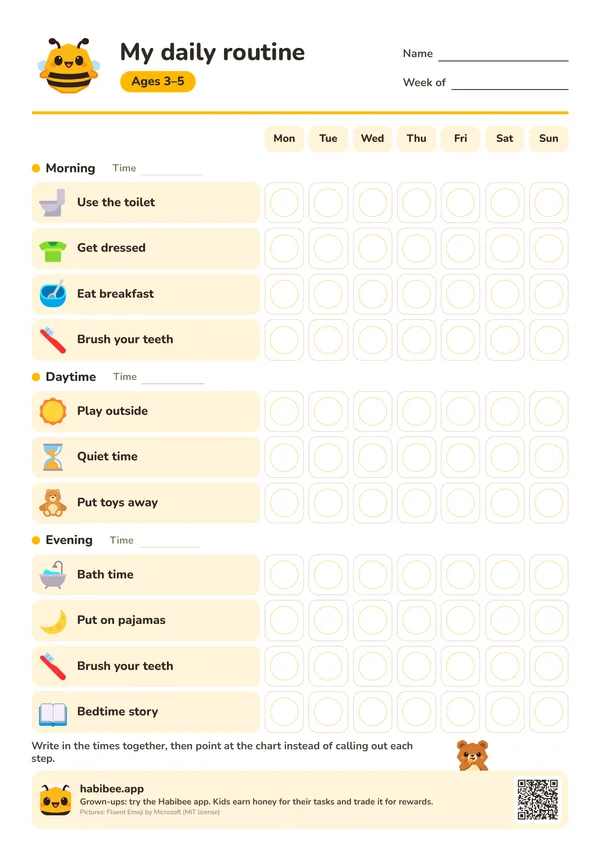
Put it next to the homework spot, and tick it together at the end of each session.
Frequently asked questions
How long should homework take for a 7-year-old?
The guideline in the U.S. Department of Education booklet is 10 to 20 minutes per school day from kindergarten to grade 2, and 30 to 60 minutes in grades 3 to 6, with reading sometimes a bit more. If your 7-year-old regularly needs much longer, talk to the teacher.
Should kids do homework right after school?
Not necessarily. The booklet says the best schedule is the one that works for your child and your family: some children work best in the afternoon, some after an hour of play, some after dinner. The one thing to avoid is leaving it until just before bedtime.
Should I help my child with homework?
Yes, in the right way. Be available, help your child understand the task, and look over the finished work, but let them do the thinking. In the sixth-grade study above, help that children found supportive went with better progress, and help they found intrusive with worse.
Should I reward my child for doing homework?
A simple reward for the steps your child controls, like starting on time and finishing, can help a child who is stuck in a refusal pattern. Keep it small and plan to fade it out once the routine runs on its own. We'd keep rewards off grades, which your child can't fully control.
What if my child says there's no homework?
Keep the homework time anyway and use it for reading or practice. The booklet notes that a set amount of time each school night can discourage "forgetting" assignments. If it keeps happening, check with the teacher how homework is given out.
In Habibee, homework is a task with photo proof by default: your child sees it on their list, takes a photo of the finished work, and you approve it with a tap. Approved tasks earn honey, which your child saves up for rewards in The Hive. It's out in November 2026; join the waitlist at habibee.app.
Sources
- U.S. Department of Education (2002). Helping your child with homework: for parents of children in elementary through middle school
- Nemours KidsHealth: Top 10 homework tips
- Cooper, Robinson & Patall (2006). Does homework improve academic achievement? A synthesis of research, 1987–2003. Review of Educational Research
- Patall, Cooper & Robinson (2008). Parent involvement in homework: a research synthesis. Review of Educational Research
- Moroni, Dumont, Trautwein, Niggli & Baeriswyl (2015). The need to distinguish between quantity and quality in research on parental involvement: the example of parental help with homework. Journal of Educational Research
- Dumont, Trautwein, Nagy & Nagengast (2014). Quality of parental homework involvement: predictors and reciprocal relations with academic functioning in the reading domain. Journal of Educational Psychology
- Miller & Kelley (1994). The use of goal setting and contingency contracting for improving children's homework performance. Journal of Applied Behavior Analysis