Morning routine for kids: a before-school checklist that actually works
Published 8 min read
A morning routine for kids works when it's short, happens in the same order every day, and is visible to the child, not just in your head. Five to eight steps is enough. Pictures for kids who can't read yet. And the part that's easiest to miss: half of a good morning happens the night before, when clothes get laid out and the school bag gets packed.
Below is how to build one, a timed example for a 7:40 departure, and a checklist you can print for ages 3–5 and 6–9.
Start with the time you leave, then work backward
A lot of school-morning fights are timing problems in disguise. The plan was made for a best-case child, and the real one needs twice as long to find the second shoe.
So start at the door. Say you need to leave at 7:40. Here's a realistic plan for a 6-year-old whose clothes and bag were sorted the evening before:
| Time | Step | Minutes |
|---|---|---|
| 6:55 | Wake up, toilet | 5 |
| 7:00 | Get dressed (clothes already on the chair) | 10 |
| 7:10 | Breakfast | 15 |
| 7:25 | Brush teeth, wash face | 7 |
| 7:32 | Shoes, coat, bag from the hallway | 5 |
| 7:37 | Spare minutes | 3 |
| 7:40 | Out the door |
That's 45 minutes. It might be too much or too little for your child, so time three ordinary mornings before you settle on a wake-up time. Write down when each step really starts. Often the time disappears between steps rather than during them: the walk from the bathroom to the bedroom that somehow involves Lego.
For a 3- or 4-year-old heading to daycare or preschool, the list is shorter but each step takes longer, because you're doing most of it together.
Most morning problems start the night before
Sleep
A tired child is a slow child. The American Academy of Sleep Medicine's consensus statement recommends 10 to 13 hours in 24 hours for children aged 3 to 5 (naps included) and 9 to 12 hours for ages 6 to 12.
Do the math backward from your wake-up time. A 6-year-old who wakes at 6:55 and does well on about 10 and a half hours needs to be asleep around 8:25, which means starting the bedtime routine well before that.
Sticking to the bedtime seems to matter too. In a US poll of 1,103 parents of 6- to 17-year-olds, children whose parents enforced a bedtime rule slept about an hour longer on school days than children without one. That's before adjusting for anything else; in the fuller analysis, an always-enforced bedtime was tied to better sleep quality rather than extra hours. Either way, it lines up with the AAP's plain advice in its back-to-school tips: set "a consistent bedtime for your child and stick with it every night."
Move decisions to the evening
Anything that involves choosing is slow in the morning. Choosing clothes, finding the reading folder, remembering it's library day. Move all of it to the evening, when nobody is watching the clock.
In the task library we built for our app, "Pack your school bag" is filed as a morning task but scheduled in the evening by default. That's deliberate. The two evening jobs that save the most morning time:
- Lay out tomorrow's clothes. One full outfit on a chair, socks included. Check the weather first.
- Pack the school bag. Folder, snack box, water bottle, anything that needs signing. Bag goes by the door, shoes next to it.
Morning routine checklist for kids
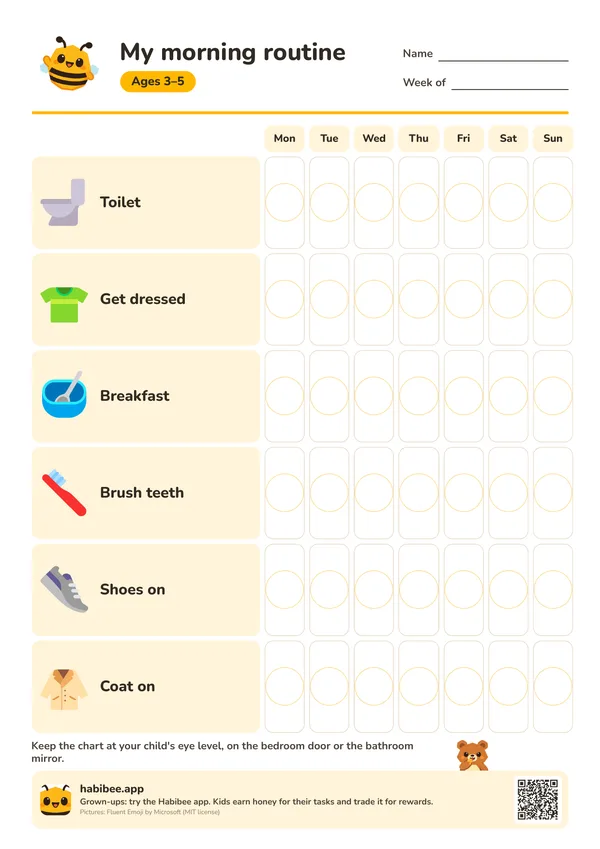
Print this, or copy it onto a sheet of paper and add a picture next to each line. Keep it where the routine happens: bedroom door or bathroom mirror, at your child's eye level.
Ages 3–5 (picture version)
Draw or photograph each step. Pre-readers follow the pictures, not the words.
- [ ] Toilet
- [ ] Get dressed
- [ ] Breakfast
- [ ] Brush teeth
- [ ] Shoes on
- [ ] Coat on
Ages 6–9
The evening before
- [ ] Clothes for tomorrow on the chair
- [ ] School bag packed and by the door
- [ ] Anything to sign? Hand it to a grown-up
In the morning
- [ ] Up and toilet
- [ ] Get dressed
- [ ] Make your bed
- [ ] Breakfast
- [ ] Brush teeth
- [ ] Wash face, brush hair
- [ ] Shoes, coat, bag
- [ ] Ready at the door on time
Keep the older list to eight lines at most. If it's longer, something belongs in the evening.
You can also print our ready-made morning routine chart (PDF, A4 or US Letter), with a picture for every step and a box to tick for each day of the week.
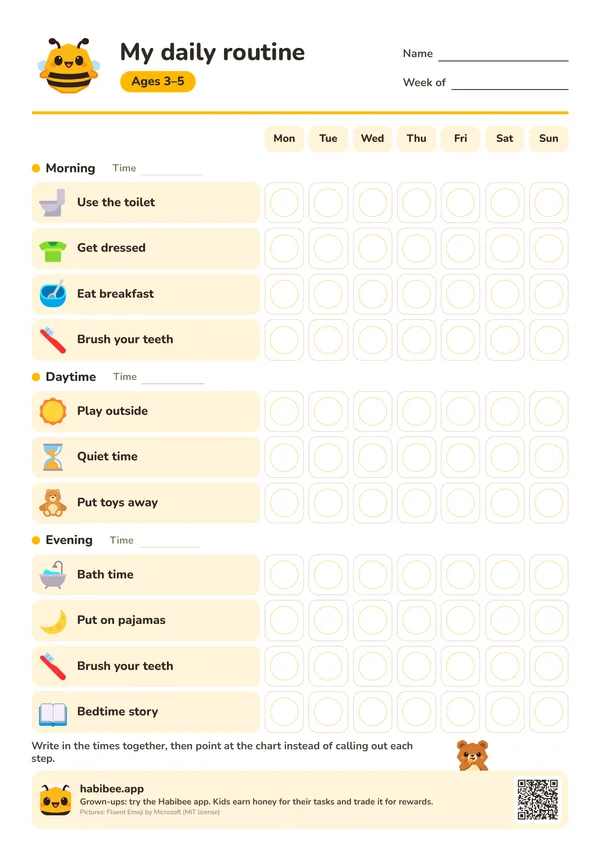
For the rest of the day, our daily routine chart puts the morning, daytime and evening steps on one page.
Want your own steps on the chart? Our free routine chart maker makes a morning and evening chart with your child's name and a picture for every step.
Same order, every day
The CDC's advice on routines for young children comes down to a few plain rules: "Routines and rules help kids feel safe and know what to expect," so be consistent, be predictable and follow through. Its example morning for a toddler runs in a fixed sequence: wake up and potty, breakfast, brush teeth and get dressed.
Which order you pick matters less than keeping it. We'd still swap two of the CDC's steps and get dressed before breakfast. Clothes are the slowest step for most young kids, and a child who's already dressed can eat as slowly as they like without making everyone late.
Stop narrating, start pointing
The routine only works if the chart does the reminding, not you. A few habits that help:
Ask, don't tell. "What's next on your chart?" instead of "Now go brush your teeth." It moves the job of remembering to your child.
One step at a time. For kids who get overwhelmed by a list, cover everything except the current step, or hand over one card at a time. In Habibee, a child can open each task as a single full-screen card for the same reason.
Use a timer for the slow step. Whatever drags (usually getting dressed), give it a kitchen timer. Racing the timer is more fun than being hurried.
Praise the specific thing, quickly. The AAP suggests you "notice good behavior and point it out" and be specific about it in its guide to discipline. "You were dressed before the timer beeped" beats "good job."
Give it two weeks. The first days will be slower than your old chaos, because everyone is learning. Don't add steps until the basic list runs without reminders.
Some mornings will fall apart anyway: a fever, a shoe that has simply ceased to exist, a night of bad dreams. On those days, get everyone out the door and skip the post-mortem in the car. The routine will still be there tomorrow.
When mornings are extra hard
For some children, mornings are much harder than for others, and it isn't about effort. A 2026 study of 205 children aged 6 to 12 in Quebec found that children with ADHD had significantly more difficulty with the morning routine than neurotypical children. The authors point to what makes mornings tricky: several steps that have to be finished by a fixed time.
If that sounds like your house, these ADHD-friendly adjustments are worth trying:
- Cut the morning list to the essentials and move everything else to the evening.
- Use pictures, even for kids who can read.
- Show one step at a time.
- Make time visible with a timer that shows how much is left, not just a beep.
- Praise each step right away, rather than one "well done" at the door.
- Keep consequences out of the morning rush. It's the worst moment to deal with them.
This guide is written by a parent, not a clinician. If you're worried about your child's attention or behavior, talk to your pediatrician.
Frequently asked questions
What time should my child wake up for school?
Work backward twice. First from the door: how long does your morning really take? Then from sleep: the AASM recommends 9 to 12 hours for ages 6 to 12, and 10 to 13 hours (including naps) for ages 3 to 5. If the wake-up time means a bedtime your child can't manage, shorten the morning before you shorten the night.
How long should a morning routine take?
It depends on the child and how much you've moved to the evening. Our example for a 6-year-old takes 45 minutes including a small buffer. Time three real mornings and plan for the slowest one, not the best.
Should kids get dressed before or after breakfast?
Either works if it's the same every day. Dressing first has one advantage: the slowest step is done early, and breakfast becomes the buffer.
Should I reward a morning routine?
A simple chart with points for the steps that cause the most friction can help, especially at the start. Keep it to two or three steps, make the reward reachable within a few days, and plan to phase it out. More in our guide on whether reward charts work.
Habibee turns this checklist into a picture-led morning routine that kids 3–12 can follow on their own, with real rewards you choose and no ads. Coming November 2026; join the waitlist at habibee.app.
Sources
- CDC: Tips for relying on routines and rules (toddlers and preschoolers)
- Paruthi et al. (2016). Recommended amount of sleep for pediatric populations: a consensus statement of the American Academy of Sleep Medicine. Journal of Clinical Sleep Medicine
- Buxton et al. (2015). Sleep in the modern family: protective family routines for child and adolescent sleep. Sleep Health
- HealthyChildren.org (AAP): Back to school tips
- Ruel et al. (2026). Challenges encountered in executing family routines: a comparison between neurotypical children and those having ADHD or ASD. Frontiers in Child and Adolescent Psychiatry
- HealthyChildren.org (AAP): What's the best way to discipline my child?