Chores and life skills for 7- to 12-year-olds, age by age
Published Updated 12 min read
Chores for 7- to 12-year-olds tend to build in a similar order. A 7-year-old can set the table, sort the recycling and feed a pet, with a checklist for the morning and evening basics. Around 8 or 9, children can clear the table, look after their own things and take on a real family job, like emptying the dishwasher. By 10, many can own one job from start to finish, including remembering it. By 11 or 12, they can load the dishwasher, do their own laundry and cook something simple with a grown-up nearby.
Below is a chore list by age, followed by a table of life skills across five areas and then each age in detail, with what "done" looks like and what to hand over next.
Chore list by age
| Age | Chores many kids can do |
|---|---|
| 7 | Set the table, sort the recycling, feed the pet, make the bed, pack the school bag |
| 8 | Clear the table, unpack the groceries, help cook, fold their own clothes, clean their own room |
| 9 | Empty the dishwasher, sweep, put away their own laundry |
| 10 | Take out the trash, walk the dog, change their own sheets |
| 11–12 | Load the dishwasher, wash the dishes, wash and fold their own laundry, cook a simple meal with an adult nearby |
For younger children, see our chores for 3- to 6-year-olds, age by age.
Life skills for kids by age at a glance
The list above is a chore list, like most lists online. Chores matter, but a 10-year-old's responsibilities also include getting ready on time, keeping track of homework and looking after their own stuff. So the table splits them into five areas.
It draws on the age lists from the American Academy of Child and Adolescent Psychiatry (AACAP) and the American Academy of Pediatrics (AAP), and on the age bands in the task library we built for our app. Treat it as a yardstick, not a test. Children differ, and a skill that one 9-year-old has nailed can still be brand new for another.
| Area | Age 7 | Age 8 | Age 9 | Age 10 | Ages 11–12 |
|---|---|---|---|---|---|
| Self-care | Teeth morning and evening, dressed, washed, with a checklist | The same, mostly without reminders | Showers alone; starts flossing | Whole morning routine, ready on time | Own hygiene without prompting |
| Own things | Bed made, floor clear | Cleans own room; folds own clothes | Puts away own laundry | Changes own sheets | Washes and folds own laundry |
| School | Packs the school bag the night before | Homework at a set time | Reads 20 minutes; keeps a tidy desk | Tracks what's due this week | Spreads test revision over several days |
| Family jobs | Sets the table, sorts recycling, feeds the pet | Clears the table, unpacks groceries, helps cook | Empties the dishwasher, sweeps | Takes out the trash, walks the dog | Loads the dishwasher, washes the dishes, cooks a simple meal with an adult nearby |
| Time and independence | Follows a written list | Beats a timer for the slow step | Keeps one weekly commitment | Remembers one job without being told | Plans the week with you |
Two caveats before you use it.
First, lists disagree at the edges. AACAP says 7- to 9-year-olds can "pack their own lunch for school". The AAP lists making and packing school lunches as early as 5 to 7. Our library files "Pack your lunch" under 9 to 12, where it means the child plans and packs it with little help. None of these is wrong. They describe different amounts of help.
Second, "can" is not "should do all of it." A child who handles every cell in their column is doing a lot. Pick a few.
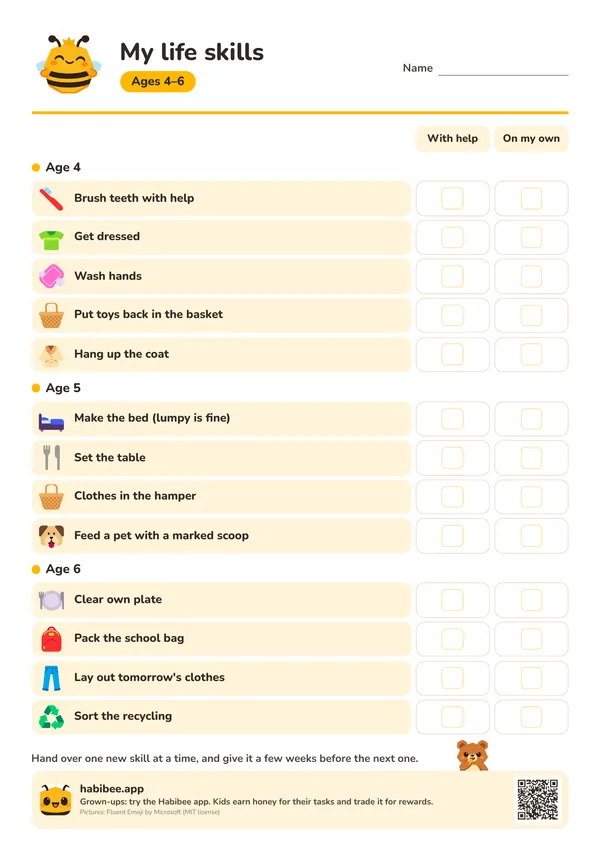
To keep track at home, print the table as a life skills checklist by age, with a box for "with help" and one for "on my own" next to every skill. It also has a page for ages 4 to 6.
Why hand over life skills at all
The honest answer is that the research is encouraging but not conclusive. In an online survey of 207 parents of 5- to 13-year-olds, most of them in Australia, self-care and family-care chores were linked to better working memory and inhibition. Pet care wasn't. The authors are clear that a one-time parent survey can't show which way the arrow points: chores might build those skills, or children who already have them might be more willing to help.
The practical case is simpler. Every job a 9-year-old owns is one fewer thing you carry in your head. And a 12-year-old who can load a dishwasher and plan a week of homework is better set up for the independence that's coming anyway.
Ages 4 to 6 in one table
If you have a younger child too, here's the short version. The full lists, with what "done" looks like at each age, are in our guide to chores for 3- to 6-year-olds.
| Age | Typical responsibilities |
|---|---|
| 4 | Teeth with help, getting dressed, washing hands, toys back in a basket, hanging up a coat |
| 5 | Making the bed (lumpy is fine), setting the table, clothes in the hamper, feeding a pet with a marked scoop |
| 6 | Clearing their own plate, packing the school bag, laying out tomorrow's clothes, sorting recycling |
Chores for 7-year-olds
PBS KIDS for Parents describes responsibility at 7 and 8 in the same words: "getting themselves ready for school, taking care of their belongings, helping with specific household chores, and looking for ways to be a helper at school and in the community." AACAP's list for 6- to 7-year-olds adds wiping tables and counters, putting laundry away and sweeping.
At 7, the skill is following a routine, not remembering it. A written or picture checklist does the remembering. Your job is to check.
Starter set in our app for a 7-year-old: brush teeth (morning), make your bed, homework, set the table, pack your school bag, brush teeth (evening).
What "done" looks like: the duvet pulled up and the pillow at the top. Folder, snack box and water bottle in the bag, bag by the door. Plates and cutlery for everyone, roughly in place.
Hand over next: laying out tomorrow's clothes. It's one more evening step, and it takes a decision out of the morning.
Chores for 8-year-olds
AACAP says children from 7 to 9 can "load and unload the dishwasher, help with meal preparation, and pack their own lunch for school." The AAP's list for 8 to 10 adds vacuuming, helping make dinner, making their own snacks, walking a pet and putting away their own laundry and the groceries.
If your 8-year-old has started to find picture charts babyish, keep the list and change the look: fewer pictures, a plainer layout, the same tasks. Our app does this by switching the child's screen to a calmer "big-kids look" from age 8, with goals and progress first and no cartoons.
Starter set: brush teeth (morning), make your bed, homework, clear the table, pack your school bag, brush teeth (evening).
What "done" looks like: their own plate, cup and cutlery taken to the kitchen and scraped. Homework finished and shown to you, not just "I did it."
Hand over next: their own room. Start with "floor clear, things put away" and nothing more.
Chores for 9-year-olds
At 9, many children can take on a family job that has a real effect on everyone. Emptying the dishwasher is a good first one: it's the same every time, and nobody has to redo it if it's slightly off.
Starter set: make your bed, homework, read for 20 minutes, empty the dishwasher, pack your school bag, brush teeth (evening).
A word on the reading task: put it on the list only if reading is a struggle. If your child already reads for fun, leave it off. We explain why in our guide on whether reward charts work.
What "done" looks like: clean dishes in the right cupboards, cutlery sorted. Anything they can't reach goes on the counter for you. That counts as done.
Hand over next: showering alone, if they aren't already, and a tidy desk before homework starts.
Chores for 10-year-olds
Ten is a good age to shift from doing jobs to owning them. The difference is remembering. A 10-year-old who takes out the trash when asked is doing a chore. One who notices it's bin night and takes it out is doing a responsibility.
AACAP says 10- and 11-year-olds can "change their sheets, clean the kitchen or bathrooms, and do yard work."
Starter set: make your bed, ready on time, homework, take out the trash, read for 20 minutes, pack your school bag.
"Ready on time" is on the list because at this age the morning itself becomes the child's job. Our morning routine guide has a timed example you can plan backward from the door.
What "done" looks like: the bag out, a new bag in the bin, the lid closed. Ready means shoes on and bag in hand at the agreed time, not "nearly."
Hand over next: changing their own sheets, and a simple weekly plan: what's due, what's on which afternoon.
Chores for 11- and 12-year-olds
The AAP's list for 11 to 12 includes cleaning the kitchen, changing bedsheets, doing and folding laundry, cleaning the bathroom and cooking "a simple meal with supervision." That last one is a useful milestone to aim for: one dish, start to finish, with you in the room.
School responsibilities change too. A 12-year-old with a test on Friday can learn to review a bit each day instead of cramming on Thursday night. In our library that task is "Study for a test," and its description says it plainly: "Review your notes a little at a time." If homework itself has become a nightly fight, see our guide on how to get kids to do homework.
Starter set for 11: make your bed, homework, clean your room, take out the trash, load the dishwasher, pack your school bag. Starter set for 12: make your bed, homework, clean your room, load the dishwasher, pack your lunch, take a shower.
What "done" looks like: plates rinsed and in the rack, not piled in the sink. A lunch box with something from each group you've agreed on, in the fridge by bedtime.
Hand over next: one meal a week, with you as the kitchen assistant for once.
What counts as "done", and how to check it
Most arguments about responsibilities are really about the finish line. Agree on it before the first try, then check in a way that fits the task. In our app, each task has a default check, and the logic works on paper too:
| Task | Ages (library) | Default check |
|---|---|---|
| Make your bed | 3–12 | Photo |
| Pack your school bag | 6–12 | Photo |
| Clean your room | 6–12 | Photo |
| Lay out tomorrow's clothes | 6–12 | Photo |
| Do your homework | 6–12 | Photo |
| Load the dishwasher | 9–12 | Photo |
| Pack your lunch | 9–12 | Photo |
| Set the table / Clear the table | 3–12 / 6–12 | "I did it!" + a grown-up's look |
| Empty the dishwasher | 6–12 | "I did it!" + a grown-up's look |
| Take out the trash | 6–12 | "I did it!" + a grown-up's look |
| Ready on time | 6–12 | "I did it!" + a grown-up's look |
"Photo" tasks are the ones where the result is visible and people tend to disagree about it: a made bed, a packed bag. "I did it!" tasks are the ones you'd notice anyway, like an empty bin. On paper, the same split means "go and look" versus "take their word for it."
How to hand over a responsibility, not just a job
A job is "empty the dishwasher when I ask." A responsibility is "the dishwasher is yours." Getting from one to the other happens in three steps, and each one can take a few weeks.
- They do the job. You say when, they do it. You agree what "done" looks like and check it without redoing it. AACAP's advice fits here: "Let your child know exactly what needs to be done."
- They remember the job. It goes on a list they can see, at the same time every day. You stop reminding and start checking. The AAP notes that routines give a child "a greater chance of remembering their chores."
- They notice the job. The dishwasher is clean, so it gets emptied, without a list. This is the stage most 10- to 12-year-olds are working toward, and most adults are still working on.
If a job keeps slipping back to step one, it might be too big. Split it (cutlery basket first, then plates) or swap it for something they chose.
If every job turns into a standoff, start with our guides on a child who doesn't want to do anything and getting kids to do chores without nagging.
Frequently asked questions
What chores should a 7-year-old do?
A 7-year-old can usually handle morning and evening basics with a checklist, making the bed, packing the school bag the night before, and one or two small family jobs such as setting the table or feeding a pet. Expect to check most things. Remembering without a list comes later.
What chores should a 10-year-old do?
At 10, many children can own one family job end to end, such as taking out the trash or emptying the dishwasher, plus their own room, homework and getting ready on time. AACAP adds changing sheets and doing yard work from 10 to 11. The step up from 8 is remembering the job without being told.
How many chores should a child have a day?
There's no official number. Our app's starter sets for 7 to 12 have six tasks, and usually only two or three of them are family jobs. The rest are self-care and school. That's a good ceiling to start with. Add one only when the others happen without reminders.
What life skills should a 12-year-old have?
By 12, many children can look after their own hygiene and laundry, load a dishwasher, clean a room, plan homework and revision across a week, and cook a simple meal with an adult nearby. Pick one or two to work on at a time.
Habibee suggests a starter set for your child's age, and you can swap any task from a ready-made library of age-matched tasks. The free plan covers one child with six active tasks, the same size as the starter sets. It's out in November 2026; join the waitlist at habibee.app.
Sources
- AACAP Facts for Families: Chores and children
- HealthyChildren.org (AAP): Age-appropriate chores for children
- PBS KIDS for Parents: Responsibility at age 7
- PBS KIDS for Parents: Responsibility at age 8
- Tepper, Howell & Bennett (2022). Executive functions and household chores: Does engagement in chores predict children's cognition? Australian Occupational Therapy Journal